Obsessive-Compulsive Disorder, more commonly known as OCD, is one of the most misunderstood mental health conditions.
Many people hear the term used casually in everyday conversations.
Someone may describe themselves as “a little OCD” because they like things organized, enjoy cleanliness or pay close attention to detail.
While these habits may reflect personal preferences, they are not the same as living with Obsessive-Compulsive Disorder.
OCD is a recognised mental health condition that can significantly affect a person’s thoughts, emotions and daily life.
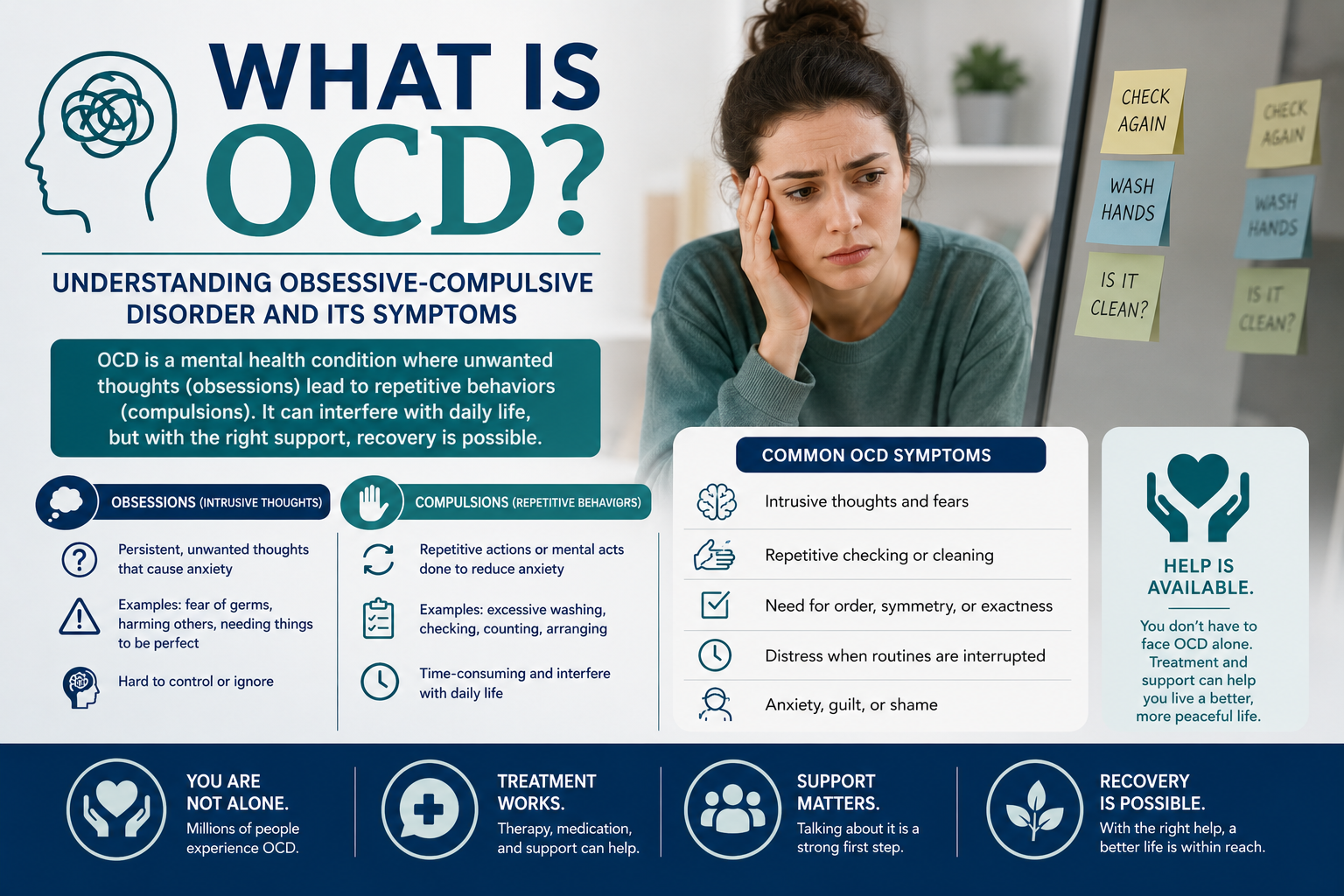
It involves recurring intrusive thoughts, images or urges that create distress, along with repetitive behaviours or mental rituals that a person feels driven to perform in an attempt to reduce that distress.
These symptoms can interfere with work, school, relationships, decision-making and overall emotional wellbeing.
For many individuals, OCD is far more than simply wanting things to be neat or orderly.
It can become a cycle that feels difficult to interrupt without appropriate understanding and professional support.
Learning more about OCD is an important first step because recognising the condition early may help individuals seek appropriate care and develop healthier ways of managing symptoms.
Quick Answer
Obsessive-Compulsive Disorder (OCD) is a mental health condition characterised by unwanted intrusive thoughts, known as obsessions, and repetitive behaviours or mental rituals, known as compulsions.
These behaviours are usually performed to reduce anxiety created by obsessive thoughts, but the relief is often temporary, allowing the cycle to repeat.
Although OCD affects every person differently, professional assessment and evidence-based treatment can help many individuals manage symptoms and improve their quality of life.
Quick Questions About OCD
What does OCD stand for?
OCD stands for Obsessive-Compulsive Disorder, a recognised mental health condition involving obsessions and compulsions that can interfere with everyday life.
Is OCD simply about being organised?
No.
Although many people associate OCD with neatness or organisation, the condition involves intrusive thoughts and repetitive behaviours that cause significant emotional distress and are much more complex than everyday preferences.
Can OCD affect anyone?
Yes.
OCD can affect children, teenagers and adults regardless of background, occupation or lifestyle.
Are intrusive thoughts a normal part of OCD?
Yes.
Many people with OCD experience intrusive thoughts that feel unwanted, repetitive and difficult to dismiss.
Can professional treatment help?
Many individuals benefit from professional assessment and evidence-based treatment that is tailored to their individual needs and circumstances.
Understanding What OCD Really Means
Obsessive-Compulsive Disorder is built around two closely connected experiences.
The first involves unwanted thoughts or fears.
The second involves behaviours or mental actions performed in response to those thoughts.
Although every person’s experience is unique, these two components often work together, creating a repeating cycle that becomes increasingly difficult to interrupt over time.
Understanding these two parts makes it easier to recognise why OCD extends far beyond common misconceptions about perfectionism or cleanliness.
| The Two Core Components of OCD | Description |
| Obsessions | Unwanted thoughts, fears, urges or mental images that repeatedly create anxiety or emotional distress. |
| Compulsions | Repetitive behaviours or mental rituals performed to reduce the anxiety caused by obsessions. |
While obsessions and compulsions often occur together, the way they appear can vary considerably from one individual to another.
Understanding Obsessions
Obsessions are persistent thoughts, urges or mental images that repeatedly enter a person’s mind.
These thoughts are usually unwanted.
Many individuals recognise that the thoughts may not be logical, yet they still experience significant anxiety because of them.
The difficulty is not simply having these thoughts.
It is the emotional distress they create and the challenge of moving past them.
Some obsessions involve fears about contamination.
Others focus on safety, uncertainty, making mistakes or causing harm.
Some individuals experience intrusive thoughts that feel disturbing or inconsistent with their personal values, making them particularly upsetting.
| Common Examples of Obsessions | How They May Affect Daily Life |
| Fear of contamination | Leads to persistent worry about germs or illness. |
| Fear of making mistakes | Creates ongoing doubt and repeated checking. |
| Excessive concern about safety | Causes constant worry about preventing harm. |
| Need for certainty | Makes uncertainty feel extremely uncomfortable. |
| Intrusive unwanted thoughts | Creates emotional distress despite recognising the thoughts are unwanted. |
These thoughts can interrupt concentration, reduce productivity and contribute to ongoing emotional discomfort throughout the day.
Understanding Compulsions
Compulsions are repetitive behaviours or mental actions performed in response to obsessive thoughts.
People living with OCD often feel that completing these behaviours will reduce anxiety or prevent something bad from happening.
Although the behaviour may provide temporary relief, the underlying anxiety usually returns, allowing the cycle to continue.
Compulsions may be visible to others, such as repeatedly checking locks or washing hands, while others occur entirely within the person’s mind through silent rituals or repeated mental phrases.
| Common Examples of Compulsions | Purpose They May Serve |
| Repeated checking | Attempts to reduce uncertainty or fear. |
| Excessive cleaning | Seeks relief from contamination fears. |
| Counting rituals | Creates a temporary sense of control. |
| Repeated reassurance seeking | Attempts to reduce ongoing doubt. |
| Mental rituals | Internal repetition intended to decrease anxiety. |
Although compulsions may reduce distress for a short period, they rarely solve the underlying problem and often reinforce the OCD cycle instead.
Understanding the OCD Cycle
One reason OCD can become so challenging is that symptoms often repeat in a predictable pattern.
An intrusive thought creates anxiety.
The anxiety becomes uncomfortable.
A compulsive behaviour is performed in an effort to reduce that discomfort.
Temporary relief follows.
Before long, another intrusive thought appears and the process begins again.
Understanding this cycle helps explain why OCD can persist without appropriate support.
| Stage of the OCD Cycle | What Happens |
| Obsession | An unwanted thought, fear or mental image appears. |
| Emotional distress | Anxiety or discomfort increases. |
| Compulsion | A behaviour or mental ritual is performed. |
| Temporary relief | Anxiety decreases briefly. |
| Cycle repeats | Another intrusive thought restarts the pattern. |
Recognising this pattern is often one of the first steps in understanding how OCD affects everyday life.
How Common Is OCD?
Obsessive-Compulsive Disorder affects people from many different backgrounds and age groups.
It may develop during childhood, adolescence or adulthood.
Some individuals receive support relatively early.
Others may experience symptoms for many years before recognising that what they are experiencing could be related to OCD.
Because symptoms vary considerably, some people mistakenly believe their experiences are simply part of their personality rather than a treatable mental health condition.
Greater awareness continues helping more individuals recognise when professional assessment may be appropriate.
Common Signs and Symptoms of OCD
Although OCD affects each person differently, certain patterns are commonly recognised by mental health professionals.
Symptoms often involve recurring intrusive thoughts together with behaviours that feel difficult to resist.
Over time these experiences may begin affecting daily responsibilities, relationships and emotional wellbeing.
| Common Symptom | How It May Present |
| Intrusive thoughts | Persistent unwanted thoughts that create anxiety. |
| Repetitive behaviours | Performing actions repeatedly despite recognising they may not be necessary. |
| Difficulty controlling thoughts | Feeling unable to dismiss recurring worries. |
| Excessive need for certainty | Ongoing discomfort with doubt or uncertainty. |
| Time-consuming rituals | Spending significant time completing repetitive behaviours or mental rituals. |
When these symptoms become persistent or begin interfering with everyday functioning, seeking guidance from a qualified mental health professional may be beneficial.
OCD Is About Much More Than Cleanliness
One of the most common misconceptions about Obsessive-Compulsive Disorder is that it only involves excessive cleaning or a preference for organisation.
While some individuals with OCD do experience contamination-related fears, these represent only one of many possible ways the condition can present.
OCD is not defined by a person’s interest in cleanliness.
Instead, it is characterised by intrusive thoughts that create significant anxiety and repetitive behaviours or mental rituals performed in response to those thoughts.
The specific themes can vary considerably from one individual to another.
Some people experience persistent concerns about safety.
Others struggle with overwhelming uncertainty, perfectionism, relationship doubts or intrusive thoughts that feel disturbing despite not reflecting their personal values.
Understanding this diversity is important because it helps reduce misconceptions and encourages more people to recognise when professional support may be beneficial.
| Common OCD Themes | How They May Present |
| Contamination concerns | Persistent fears related to germs, illness or cleanliness. |
| Safety concerns | Worry about accidentally causing harm or forgetting important tasks. |
| Perfectionism | Excessive concern about mistakes or things feeling “not quite right.” |
| Relationship concerns | Ongoing doubts about important relationships despite reassurance. |
| Health-related fears | Persistent anxiety about illness or physical wellbeing. |
| Intrusive thoughts | Unwanted thoughts or mental images that create significant emotional distress. |
Because OCD can appear in many different forms, it is often misunderstood by both the public and those experiencing symptoms themselves.
How OCD Can Affect Everyday Life
Obsessive-Compulsive Disorder affects much more than thoughts alone.
The condition can influence how individuals work, study, manage relationships and complete everyday responsibilities.
Many people living with OCD spend considerable amounts of time managing intrusive thoughts or performing compulsive behaviours.
This can reduce concentration, interrupt productivity and make ordinary daily activities feel much more challenging.
Some individuals may begin avoiding certain situations altogether because they fear triggering obsessive thoughts or compulsive rituals.
Over time, these patterns may begin affecting confidence, independence and overall quality of life.
| Area of Daily Life | Possible Impact of OCD |
| Work | Difficulty concentrating, completing tasks or making decisions. |
| School | Challenges with focus, assignments or examinations. |
| Relationships | Increased stress caused by recurring worries or compulsive behaviours. |
| Daily routines | Time-consuming rituals that interfere with everyday responsibilities. |
| Emotional wellbeing | Ongoing anxiety, frustration and mental exhaustion. |
Although the severity of symptoms varies, OCD can become increasingly disruptive when left unrecognised or untreated.
Why OCD Often Goes Unrecognised
Many people living with OCD do not immediately realise that their experiences may represent a recognised mental health condition.
Some assume their thoughts are simply part of their personality.
Others worry that discussing intrusive thoughts may cause embarrassment or lead to misunderstanding.
Because intrusive thoughts can feel highly personal, many individuals choose to keep their experiences private for years.
This delay often prevents people from receiving professional assessment and support that could help them better understand and manage their symptoms.
Greater awareness continues helping reduce stigma and encourages more individuals to seek help when symptoms begin interfering with everyday life.
| Common Barriers to Seeking Help | Why They Delay Diagnosis |
| Embarrassment | Individuals may feel uncomfortable discussing intrusive thoughts. |
| Fear of misunderstanding | Concerns about how others may interpret symptoms. |
| Believing symptoms are personality traits | Many people do not initially recognise OCD. |
| Limited awareness | Lack of understanding about how OCD actually presents. |
Improving public understanding of OCD is an important step toward reducing these barriers.
The Emotional Impact of Living With OCD
Living with OCD can be emotionally exhausting.
Many individuals describe feeling trapped in a cycle that is difficult to interrupt, even when they recognise their fears may not be rational.
The constant effort required to manage intrusive thoughts and repetitive behaviours can contribute to ongoing emotional strain.
People commonly report feeling frustrated when compulsions consume increasing amounts of time.
Others experience anxiety because intrusive thoughts continue returning despite repeated attempts to manage them.
Over time, this cycle may affect confidence, relationships and overall emotional wellbeing.
Recognising these emotional effects helps create a more complete understanding of OCD beyond its visible symptoms.
Why Early Recognition Matters
Recognising OCD symptoms early allows individuals to seek professional guidance before symptoms become increasingly disruptive.
Early assessment does not simply focus on diagnosis.
It also helps people better understand what they are experiencing and explore treatment options that may improve daily functioning.
Professional support may help individuals develop healthier coping strategies while reducing the impact OCD has on work, education, relationships and overall wellbeing.
| Benefits of Early Recognition | How It May Help |
| Earlier professional assessment | Supports timely diagnosis and treatment planning. |
| Better symptom management | Helps reduce the impact of obsessions and compulsions. |
| Improved daily functioning | Supports work, school and personal relationships. |
| Greater emotional wellbeing | Helps reduce ongoing anxiety and distress. |
Understanding the warning signs of OCD is often the first step towards receiving appropriate mental health care.
What Causes OCD?
Researchers continue studying the exact causes of Obsessive-Compulsive Disorder.
Although there is no single explanation, current evidence suggests that several biological, psychological and environmental factors may contribute to its development.
Every individual’s experience is unique, and symptoms often arise through a combination of influences rather than one specific cause.
Some research suggests that differences in brain function may play a role.
Family history may also increase the likelihood of developing OCD in certain individuals.
Stressful life experiences and environmental influences have likewise been associated with the onset or worsening of symptoms for some people.
| Possible Contributing Factors | Description |
| Biological factors | Differences in brain function may contribute to OCD symptoms. |
| Family history | A family history of OCD or other mental health conditions may increase risk. |
| Stressful life experiences | Significant stress may contribute to symptom onset or worsening. |
| Environmental influences | Various environmental factors may affect how symptoms develop. |
Because OCD develops differently in every individual, a comprehensive mental health evaluation is often needed to understand each person’s circumstances.
Can OCD Improve With Professional Treatment?
Yes.
One of the most encouraging aspects of OCD is that effective treatment is available.
Many individuals experience meaningful improvements after receiving evidence-based care from qualified mental health professionals.
Treatment is designed to help reduce the impact of obsessive thoughts and compulsive behaviours while improving everyday functioning.
Although progress differs from person to person, many individuals learn practical strategies that allow them to manage symptoms more effectively and improve their quality of life.
| Treatment Goals | Potential Benefits |
| Reduce symptom severity | Less interference from obsessions and compulsions. |
| Improve daily functioning | Greater confidence at work, school and home. |
| Develop coping strategies | Healthier ways of responding to intrusive thoughts. |
| Improve overall wellbeing | Better emotional health and quality of life. |
Seeking professional support early often provides the greatest opportunity for effective long-term symptom management.
How Is OCD Diagnosed?
Obsessive-Compulsive Disorder is typically diagnosed through a comprehensive psychiatric or psychological evaluation conducted by a qualified mental health professional.
Rather than relying on a single test, clinicians develop an understanding of the individual’s experiences through detailed discussion and clinical assessment.
During the evaluation, questions often focus on the nature of intrusive thoughts, compulsive behaviours, how frequently symptoms occur and the extent to which they affect daily life.
Previous medical history, emotional wellbeing and mental health history may also be reviewed to ensure an accurate assessment.
| Areas Commonly Discussed During Assessment | Purpose |
| Current symptoms | Understand obsessive thoughts and compulsive behaviours. |
| Symptom frequency | Assess how often symptoms occur. |
| Daily impact | Evaluate effects on work, education and relationships. |
| Medical history | Consider physical health factors. |
| Mental health history | Develop a complete understanding before treatment planning. |
A comprehensive evaluation allows mental health professionals to recommend treatment approaches that are appropriate for each individual’s specific needs and circumstances.
Treatment Options for OCD
Obsessive-Compulsive Disorder is a treatable mental health condition, and many individuals experience meaningful improvement with appropriate professional care.
Because OCD affects people differently, treatment plans are personalised to reflect each individual’s symptoms, daily challenges and overall mental health needs.
The goal of treatment is not simply to reduce symptoms.
It is to help individuals improve their quality of life, develop effective coping strategies and regain confidence in their daily routines.
Several approaches may be considered depending on the person’s circumstances and the recommendations of a qualified mental health professional.
| Treatment Approach | How It May Help |
| Therapy | Helps individuals understand symptoms and develop healthier coping strategies. |
| Medication management | May be recommended as part of a comprehensive treatment plan for some individuals. |
| Lifestyle support | Healthy daily habits can contribute to overall emotional wellbeing. |
| Ongoing follow-up | Allows treatment plans to be reviewed and adjusted when appropriate. |
Successful treatment often combines multiple approaches rather than relying on a single strategy.
Why Professional Evaluation Is So Important
Many people attempt to manage OCD symptoms on their own for months or even years before seeking professional support.
Some believe the symptoms will eventually disappear.
Others assume the thoughts are simply part of their personality or feel uncomfortable discussing them with anyone else.
Unfortunately, OCD symptoms often become more disruptive when they remain untreated.
A professional mental health evaluation provides an opportunity to understand what is happening and develop an evidence-based treatment plan based on the individual’s specific needs.
Early assessment may also reduce unnecessary uncertainty while helping individuals access appropriate care sooner.
| Benefits of Professional Evaluation | Why It Matters |
| Accurate identification of symptoms | Helps distinguish OCD from other mental health conditions. |
| Clarifies individual concerns | Provides a better understanding of the person’s experiences. |
| Personalised treatment planning | Supports more effective symptom management. |
| Improved quality of life | Helps reduce the impact of symptoms on everyday functioning. |
Professional assessment provides the foundation for informed treatment decisions and ongoing mental health care.
Common Misconceptions About OCD
Despite growing awareness, many misconceptions about OCD continue to exist.
These misunderstandings can contribute to stigma while preventing some individuals from recognising when they may benefit from professional support.
One of the most common myths is that OCD simply means someone enjoys keeping things clean.
Although contamination concerns can occur, many individuals experience symptoms that have nothing to do with cleanliness or organisation.
Another misconception is that everyone is “a little OCD.”
In reality, OCD is a recognised mental health condition rather than a personality trait or personal preference.
Some people also believe individuals with OCD can simply stop performing compulsive behaviours if they try hard enough.
However, compulsions are usually driven by significant anxiety and are far more complex than ordinary habits.
| Common Misconception | Reality |
| OCD only involves cleanliness. | OCD can involve many different themes beyond contamination. |
| Everyone is a little OCD. | OCD is a recognised mental health condition, not a personality characteristic. |
| People can simply stop compulsions. | Compulsive behaviours are driven by significant emotional distress and anxiety. |
| OCD is uncommon. | OCD affects many individuals across different ages and backgrounds. |
Increasing awareness helps reduce stigma while encouraging individuals to seek appropriate support.
How OCD Can Affect Relationships
Although OCD primarily affects the individual experiencing symptoms, its impact often extends to family members, friends and colleagues.
Loved ones may struggle to understand why repetitive behaviours continue even when reassurance has been provided.
Without an understanding of OCD, these situations can sometimes create frustration, confusion or communication difficulties.
Education plays an important role in helping families better understand the condition.
When loved ones recognise that obsessive thoughts and compulsive behaviours are symptoms of a mental health condition rather than deliberate choices, communication often becomes more supportive and compassionate.
Professional guidance can also help families develop healthier ways of supporting someone living with OCD.
Supporting Someone Living With OCD
Supporting a friend or family member with OCD does not require having all the answers.
Often, the most valuable support begins with understanding, patience and a willingness to listen without judgement.
Learning more about OCD helps family members better appreciate the challenges individuals experience each day.
Encouraging professional support can also make a meaningful difference while respecting the person’s own decisions regarding treatment.
Recovery is often gradual, and progress may occur over time rather than immediately.
Supportive relationships frequently play an important role throughout that journey.
| Ways to Offer Support | Why It Helps |
| Listen without judgement | Creates a safe environment for open conversation. |
| Learn about OCD | Improves understanding of symptoms and challenges. |
| Encourage professional care | Supports access to evidence-based treatment. |
| Be patient | Recognises that improvement often takes time. |
Compassion, understanding and education can make a significant difference for individuals living with OCD.
Living Well With OCD
Receiving an OCD diagnosis does not prevent someone from leading a productive and fulfilling life.
Many individuals successfully manage their symptoms through professional treatment, healthy daily routines and strong support systems.
Long-term management often focuses on maintaining emotional wellbeing while developing practical strategies that help reduce the impact of obsessive thoughts and compulsive behaviours.
Healthy sleep habits, regular physical activity, stress management and ongoing mental health care may all contribute to overall wellbeing.
Although everyone’s journey is different, many individuals find that symptoms become much more manageable with appropriate treatment and continued support.
| Long-Term Wellness Strategies | Potential Benefits |
| Professional mental health care | Supports ongoing symptom management. |
| Healthy sleep routines | Promotes emotional and physical wellbeing. |
| Stress management | Helps reduce emotional strain. |
| Regular physical activity | Supports overall mental health. |
| Strong support networks | Encourages long-term recovery and resilience. |
Living well with OCD is often an ongoing process, but meaningful improvement is possible with appropriate care and support.
Frequently Asked Questions
What does OCD stand for?
OCD stands for Obsessive-Compulsive Disorder, a mental health condition characterised by intrusive obsessions and repetitive compulsions.
What are obsessions?
Obsessions are unwanted thoughts, urges or mental images that repeatedly create anxiety or emotional distress.
What are compulsions?
Compulsions are repetitive behaviours or mental rituals performed in an attempt to reduce the anxiety associated with obsessive thoughts.
Is OCD only related to cleanliness?
No.
Although some people experience contamination concerns, OCD can also involve safety fears, perfectionism, intrusive thoughts, relationship doubts and many other themes.
Can OCD interfere with everyday life?
Yes.
Symptoms may affect work, education, relationships, decision-making and routine daily activities when they become persistent or severe.
How is OCD diagnosed?
OCD is typically diagnosed through a comprehensive psychiatric or psychological evaluation conducted by a qualified mental health professional.
Is OCD treatable?
Yes.
Many individuals experience significant improvement through evidence-based treatment, professional guidance and ongoing support.
What causes OCD?
Researchers believe OCD develops through a combination of biological, genetic, environmental and life-related factors rather than a single cause.
Should someone seek professional help if symptoms interfere with daily life?
Yes.
If obsessive thoughts or compulsive behaviours begin affecting everyday functioning, a professional evaluation can help clarify symptoms and discuss appropriate treatment options.
Can people with OCD live fulfilling lives?
Absolutely.
Many individuals successfully manage OCD while maintaining rewarding personal relationships, productive careers and meaningful daily lives.
Conclusion
Obsessive-Compulsive Disorder is a complex but treatable mental health condition that affects far more than cleanliness or organisation.
As we have explored throughout this guide, OCD involves recurring obsessions and compulsions that can influence emotional wellbeing, daily routines, relationships and overall quality of life.
Greater awareness helps reduce misunderstanding while encouraging earlier recognition of symptoms.
The earlier individuals receive appropriate assessment and evidence-based care, the greater the opportunity to develop effective coping strategies and improve long-term wellbeing.
Although living with OCD can be challenging, many people experience meaningful improvement through personalised treatment, professional support and healthy daily routines.
Recognising the signs is often the first step.
Seeking professional guidance when symptoms begin affecting everyday life is the next.