
Anxiety Symptoms and Two-Minute Self-Check
Anxiety Symptoms and Two-Minute Self-Check
Anxiety can feel like constant worry, racing thoughts, physical tension, irritability, or the sense that something bad is about to happen. For some people, the symptoms are mainly mental. For others, a racing heart, stomach discomfort, shortness of breath, dizziness, or trouble sleeping becomes the first sign that something is wrong.
If you have been searching “do I have anxiety?” or looking for an online anxiety test, this page can help you identify common symptoms, complete a recognized GAD-7 self-check, and understand when a psychiatric evaluation may be appropriate
The self-check is educational. It cannot diagnose an anxiety disorder, identify every type of anxiety, or replace an evaluation by a qualified healthcare professional.
Quick Answer: What Are the Most Common Anxiety Symptoms?
Common anxiety symptoms include excessive worry, difficulty controlling worry, nervousness, restlessness, irritability, trouble relaxing, fear that something bad may happen, muscle tension, poor concentration, sleep problems, fatigue, sweating, trembling, stomach discomfort, dizziness, shortness of breath, or a racing heartbeat.
Occasional anxiety is a normal response to stress, uncertainty, or danger. A professional evaluation becomes more important when anxiety is difficult to control, continues even when no immediate threat is present, causes avoidance, or interferes with work, relationships, school, sleep, health, or ordinary daily activities.
You do not need to wait for anxiety to become unbearable. Persistent worry, physical symptoms, panic, or changes in how you live are valid reasons to ask for help
Anxiety Can Affect Thoughts, Emotions, and the Body
Anxiety is not only “being worried.” It can involve a wide range of cognitive, emotional, physical, and behavioral symptoms.
Worry and racing thoughts
You may repeatedly think about work, health, money, family, relationships, mistakes, deadlines, or events that have not happened. One concern may be replaced by another as soon as it is resolved.
You might recognize that the worry is excessive but still feel unable to stop it. Reassurance may provide only brief relief before doubt returns.
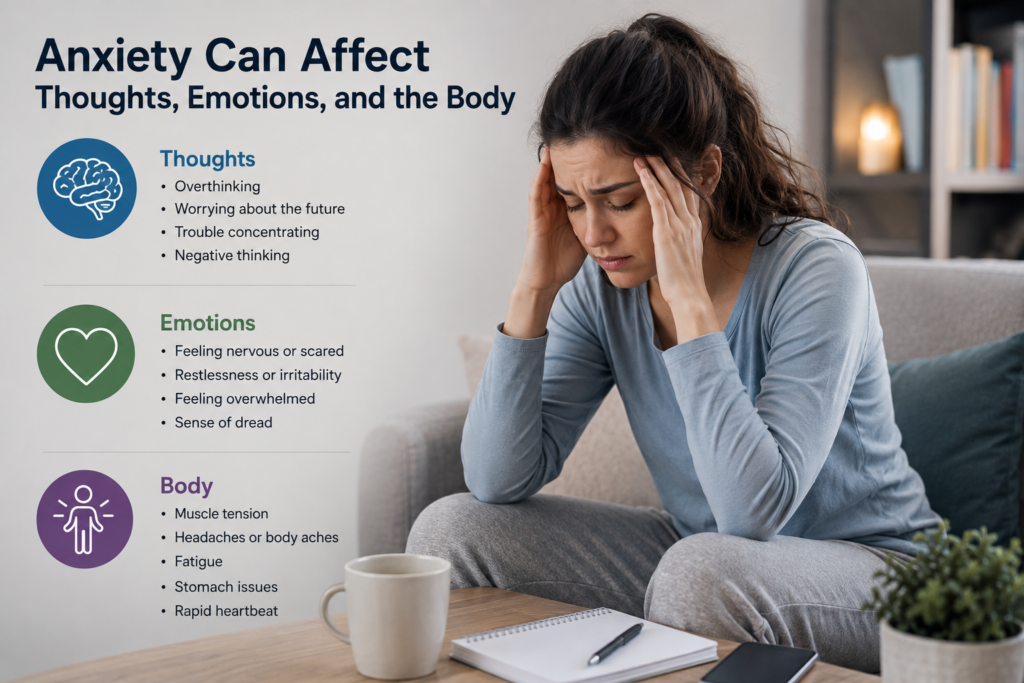
Feeling constantly on edge
Anxiety may create a persistent sense of alertness. You may feel as though you need to watch for problems, prepare for every possible outcome, or remain in control at all times.
Small disruptions can feel unusually intense. You may become easily startled, impatient, frustrated, or sensitive to noise, messages, uncertainty, or changes in plans.
Difficulty relaxing
Rest may feel uncomfortable rather than restorative. When you try to slow down, your thoughts may become louder.
You might stay busy, scroll, work, clean, exercise, or plan because being still allows worry to surface. This can create a cycle in which the body is tired but the mind continues to anticipate problems.
Concentration and decision-making problems
Worry uses mental attention. You may reread information, lose track of conversations, forget tasks, struggle to make choices, or feel mentally scattered.
Decision-making can become difficult when every option triggers a new set of possible consequences. Some people delay decisions, while others repeatedly seek reassurance.
Sleep disruption and fatigue
Anxiety can make it difficult to fall asleep, stay asleep, or return to sleep after waking. You may review the day, plan for tomorrow, or imagine negative outcomes while lying in bed.
Poor sleep can increase irritability, physical tension, concentration problems, and emotional sensitivity. Even when sleep duration appears adequate, the person may wake feeling unrested.
Physical anxiety symptoms
Anxiety can affect the autonomic nervous system and create symptoms such as:
- A pounding or racing heartbeat.
- Chest tightness or discomfort.
- Shortness of breath or rapid breathing.
- Sweating, trembling, or feeling shaky.
- Dizziness or lightheadedness.
- Nausea, stomach pain, diarrhea, or digestive changes.
- Muscle tension, jaw clenching, headaches, or body pain.
- Tingling, numbness, chills, or hot sensations.
- Frequent urination or difficulty swallowing.
Physical symptoms should not automatically be assumed to be anxiety.
New, severe, or concerning symptoms may require medical evaluation, especially chest pain, fainting, breathing difficulty, or symptoms that could indicate an emergency.
Avoidance and reassurance-seeking
Anxiety can change behavior. You may avoid driving, flying, crowds, meetings, public speaking, social situations, medical appointments, unfamiliar places, or anything associated with a previous panic experience.
You may repeatedly check locks, messages, health information, work, or another person’s safety. You may ask for reassurance even when you know the relief will not last.
Avoidance can reduce anxiety temporarily while making life increasingly narrow. The specific pattern may help a clinician determine whether generalized anxiety, panic, social anxiety, OCD, trauma-related symptoms, or another concern is present.
Normal Anxiety vs an Anxiety Disorder
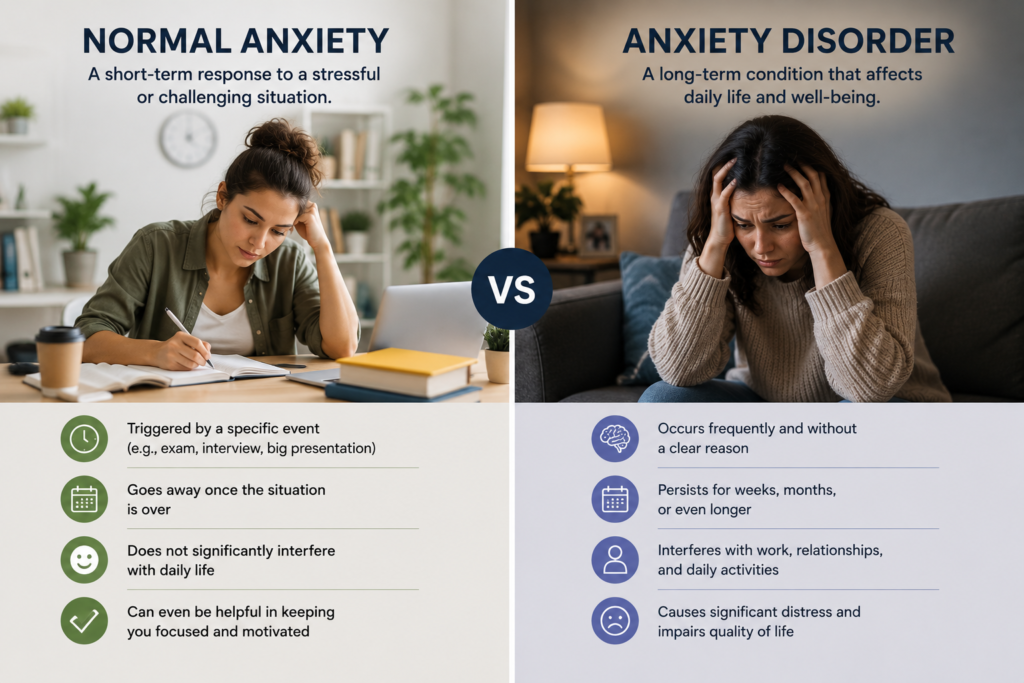
Anxiety is part of the body’s response to challenge and uncertainty. Feeling nervous before an interview, worried during a medical problem, or tense before a major decision does not automatically indicate an anxiety disorder.
Normal anxiety usually has a recognizable trigger, is proportionate to the situation, and becomes more manageable when the event passes. It may be uncomfortable without controlling the person’s life.
An anxiety disorder may be more likely when fear or worry is persistent, difficult to control, disproportionate to the actual situation, present without a clear threat, or causing significant distress and avoidance.Generalized anxiety disorder involves excessive worry about multiple areas of life that is difficult to control. Clinicians consider the duration, associated symptoms, and effect on functioning. A GAD-7 score alone cannot establish that diagnosis.
Take the Two-Minute GAD-7 Anxiety Self-Check
The GAD-7 is a recognized seven-question screening instrument. It measures how often you experienced common generalized anxiety symptoms during the past two weeks.
Choose one response for each question:
- Not at all — 0 points
- Several days — 1 point
- More than half the days — 2 points
- Nearly every day — 3 points
During the past two weeks, how often have you been bothered by the following problems?
- Feeling nervous, anxious, or on edge?
- Not being able to stop or control worrying?
- Worrying too much about different things?
- Trouble relaxing?
- Being so restless that it is hard to sit still?
- Becoming easily annoyed or irritable?
- Feeling afraid as if something awful might happen?
Additional question, not included in the score: If you selected any problems, how difficult have they made it for you to do your work, take care of things at home, or get along with other people?
- Not difficult at all
- Somewhat difficult
- Very difficult
- Extremely difficult
How to score the GAD-7
Add the points for questions 1 through 7. Your total will be between 0 and 21.
Total score | Reported anxiety symptom range | Suggested next step |
0–4 | Minimal | Monitor how you feel. Consider a consultation if symptoms persist, cause avoidance, or interfere with daily life. |
5–9 | Mild | Consider discussing ongoing or difficult symptoms with a healthcare professional. |
10–14 | Moderate | A professional anxiety evaluation may be worthwhile. |
15–21 | Severe | Contact a qualified mental health professional for a timely evaluation. Use emergency or crisis support for any immediate safety concern. |
Your score is not a diagnosis. A higher score means you reported more frequent generalized anxiety symptoms during the past two weeks.
A lower score does not rule out panic disorder, social anxiety, a phobia, OCD, trauma-related symptoms, health anxiety, substance-related anxiety, or another condition.
What Does My GAD-7 Result Mean?
The result can help organize your symptoms and support a conversation with a healthcare professional. It should be interpreted together with duration, distress, functioning, physical health, medications, substance use, and the type of anxiety you are experiencing.
Scores from 0 to 4: minimal symptom range
A result in this range means you reported few of the generalized anxiety symptoms included in the questionnaire. It does not mean that every anxiety concern is absent.
You may still have distressing panic attacks, a specific fear, intrusive thoughts, trauma triggers, or anxiety limited to a particular situation.
Consider an evaluation when symptoms are intense, recurring, or changing how you live, even if the total is low.
Scores from 5 to 9: mild symptom range
Mild anxiety symptoms can still affect sleep, patience, concentration, confidence, and relationships.
You may remain able to meet responsibilities while using significant energy to manage worry or physical tension.
Consider discussing the symptoms when they persist, become more frequent, or lead you to avoid situations, seek repeated reassurance, or rely on alcohol or other substances to cope.
Scores from 10 to 14: moderate symptom range
A result in this range suggests that several generalized anxiety symptoms may be occurring often enough to affect well-being or daily functioning.
A psychiatric or mental health evaluation can help determine whether the pattern may reflect generalized anxiety disorder, another type of anxiety, depression with anxiety, a medical concern, medication effects, or several factors occurring together.
Scores from 15 to 21: severe symptom range
A result in this range indicates a high level of reported generalized anxiety symptoms and deserves timely professional attention.
Contact a qualified mental health professional for an evaluation. If you may hurt yourself or someone else, cannot remain safe, or are in immediate danger, call 911 or go to the nearest emergency room.
Call or text 988 for immediate crisis support in the United States.
What the GAD-7 Can and Cannot Tell You
The GAD-7 is useful because it provides a consistent way to describe the frequency of common anxiety symptoms. It may also help a clinician monitor whether symptoms change over time.
It cannot:
- Confirm that you have generalized anxiety disorder.
- Rule out an anxiety disorder when the score is low.
- Identify the cause of anxiety.
- Distinguish every anxiety-related condition.
- Determine whether physical symptoms are medical or psychiatric.
- Replace a clinical interview or medical assessment.
- Recommend a specific treatment based only on the score.
- Evaluate suicide or self-harm risk.
Do not use the score as the only reason to seek or delay care. Your distress, functioning, safety, avoidance, physical symptoms, and change from your usual self all matter.
Anxiety Does Not Look the Same for Everyone
People often use “anxiety” as one broad term, but different conditions can create different patterns.
Generalized anxiety
Generalized anxiety often involves ongoing worry across several areas, such as health, work, finances, family, responsibilities, or the future.
The worry may shift from one topic to another and feel difficult to control.
Panic attacks and panic disorder
A panic attack is a sudden surge of intense fear or discomfort that may involve a racing heart, chest discomfort, shortness of breath, trembling, dizziness, nausea, tingling, or fear of losing control or dying.
Not everyone who has a panic attack has panic disorder. Panic disorder involves recurring unexpected attacks along with continuing worry or behavioral changes related to future attacks.
Social anxiety
Social anxiety may involve intense fear of being judged, embarrassed, rejected, watched, or evaluated.
A person may avoid conversations, meetings, eating in public, dating, speaking, or other social and performance situations.
Specific phobias
A phobia involves intense fear related to a particular object or situation, such as flying, heights, animals, needles, or enclosed spaces.
The fear may lead to avoidance even when the person recognizes that the reaction is excessive.
OCD and intrusive thoughts
OCD may involve intrusive, unwanted thoughts, images, or urges and repetitive behaviors or mental rituals intended to reduce distress or prevent a feared event.
OCD is not simply worrying a lot, and the GAD-7 does not evaluate compulsions.
Trauma-related anxiety
Trauma-related conditions may involve hypervigilance, nightmares, avoidance, emotional numbness, intrusive memories, exaggerated startle, irritability, or feeling unsafe after a traumatic experience.
Anxiety with depression
Anxiety and depression frequently appear together. A person may feel worried, tense, and unable to relax while also feeling low, hopeless, exhausted, or unable to experience pleasure.
An evaluation can help identify whether one or several patterns need attention.
Why Anxiety Symptoms Are Sometimes Missed
Anxiety may be overlooked when a person appears productive, organized, cautious, or highly prepared. Other people may praise behaviors that are being driven by fear.
Hidden signs may include:
- Rechecking work repeatedly to avoid mistakes.
- Arriving unusually early because being late feels unbearable.
- Overpreparing for ordinary conversations or meetings.
- Avoiding opportunities that involve uncertainty.
- Asking for reassurance without feeling reassured.
- Taking on excessive responsibility to maintain control.
- Staying constantly busy because rest allows worry to surface.
- Appearing calm while experiencing strong physical symptoms.
- Using perfectionism to reduce fear of criticism or failure.
- Limiting travel, relationships, healthcare, or social activity without explaining why.
High achievement does not rule out clinically significant anxiety. The amount of internal distress and the restrictions placed on life are important.
What Else Can Cause Anxiety Symptoms?
Anxiety-like symptoms can occur with physical health conditions, medications, supplements, caffeine, nicotine, alcohol, cannabis, stimulants, withdrawal, sleep deprivation, chronic pain, hormonal changes, and other factors.
Thyroid problems, heart rhythm changes, respiratory conditions, low blood sugar, anemia, vestibular problems, and other medical concerns may produce sensations that resemble anxiety or panic.
Bipolar disorder, depression, ADHD, trauma-related conditions, OCD, substance-related conditions, and eating-related concerns may also involve restlessness, worry, irritability, sleep problems, or concentration difficulties.
Do not assume that every physical symptom is caused by anxiety. A psychiatric evaluation may include coordination with a primary care clinician or medical testing when the history suggests another possible cause.
When Should Anxiety Be Evaluated by a Psychiatrist?
Consider a psychiatric evaluation when:
- Worry feels difficult to control.
- Anxiety has continued for weeks or months.
- Symptoms interfere with sleep, work, relationships, school, parenting, or self-care.
- You avoid situations, opportunities, travel, healthcare, or people because of fear.
- Panic attacks are recurring or changing your behavior.
- Physical symptoms are frequent or distressing.
- You repeatedly seek reassurance without lasting relief.
- Anxiety and depression occur together.
- Intrusive thoughts or rituals take up significant time.
- Trauma symptoms are affecting daily life.
- Alcohol or other substance use is increasing.
- Current therapy or medication is not helping enough.
- Medication side effects are difficult to manage.
- You are unsure whether symptoms may have a medical cause.
- You have thoughts of death, self-harm, suicide, or being unable to remain safe.
You do not need to reach a particular GAD-7 score before asking for help. A psychiatrist can evaluate the pattern even when anxiety is situation-specific or not fully captured by the questionnaire.

What Happens During an Anxiety Evaluation?
A psychiatric evaluation is a conversation about the symptoms, their context, and their effect on daily life.
The clinician may ask:
- When the anxiety began and how often it occurs.
- What situations, thoughts, sensations, or memories trigger symptoms.
- Whether worry focuses on one area or many areas.
- How difficult it is to control the worry.
- Whether panic attacks occur and whether they are expected or unexpected.
- What situations you avoid or endure with intense distress.
- Whether intrusive thoughts or repetitive behaviors are present.
- How anxiety affects sleep, concentration, relationships, work, and self-care.
- Whether depression, trauma, grief, or mood changes are also present.
- Current medications, supplements, caffeine, nicotine, alcohol, and substance use.
- Medical conditions, pain, hormonal changes, and physical symptoms.
- Previous therapy, medication, and treatment response.
- Family mental health history.
- Current and past safety concerns.
The provider may also ask about past periods of unusually elevated or irritable mood, increased activity, reduced need for sleep, racing thoughts, or impulsive behavior.
A complete mood history helps guide safe treatment planning.
Anxiety Care at Sunny Skies Healthcare in Chicago
Sunny Skies Healthcare provides compassionate psychiatric care for anxiety, anxious depression, panic symptoms, trauma-related anxiety, chronic stress, and related concerns in Chicago’s West Loop.
Care begins with understanding the full pattern rather than diagnosing from an online anxiety test.
A psychiatric evaluation can review symptoms, triggers, duration, avoidance, sleep, physical health, medication history, substance use, previous treatment, safety, and goals.
Depending on the evaluation, care may include medication management when appropriate, therapy coordination, lifestyle-focused guidance, holistic mental wellness support, or additional treatment options based on the diagnosed condition and individual needs.
If anxiety is affecting how you work, sleep, connect, or move through the day, a private consultation can help you understand possible next steps.

Treatment depends on the diagnosis, severity, safety, medical history, previous treatment, and patient preferences.
Psychotherapy
Therapy can help identify patterns of worry, avoidance, reassurance-seeking, fear, and physical reactivity.
Depending on the diagnosis, treatment may involve cognitive and behavioral strategies, exposure-based work, trauma-focused care, or another evidence-based approach.
Medication management
Medication may be appropriate for some anxiety disorders or co-occurring conditions.
A psychiatric provider can review potential benefits, risks, side effects, interactions, previous treatment, and monitoring.
Do not start, stop, or change psychiatric medication without guidance from a qualified prescriber.
Sleep, medical, and lifestyle support
Sleep, movement, nutrition, routine, caffeine, nicotine, alcohol, stress, and physical health can influence anxiety symptoms.
Addressing these areas may support treatment, but they should not be presented as a cure or replacement for appropriate clinical care.
Treatment review for overlapping conditions
Anxiety may occur with depression, OCD, trauma, panic, substance use, or a medical condition. A coordinated plan may be more appropriate than treating every symptom as generalized anxiety.
Advanced treatment options such as BrainsWay Deep TMS® are not selected based on a GAD-7 score alone.
Eligibility depends on a qualifying diagnosis, treatment history, medical and safety factors, and a provider evaluation.
Frequently Asked Questions
Can an online anxiety test diagnose me?
No. An online anxiety test can help identify symptom patterns and support a conversation with a professional.It cannot diagnose generalized anxiety disorder or determine the cause of your symptoms. Diagnosis requires a broader evaluation of duration, distress, functioning, health, and other possible conditions.
What GAD-7 score means I have anxiety?
No GAD-7 score proves that you have an anxiety disorder.The score describes how frequently you reported seven generalized anxiety symptoms during the past two weeks. A clinician must determine whether those symptoms meet diagnostic criteria or may be better explained by another concern.
Can I have anxiety with a low GAD-7 score?
Yes. The GAD-7 does not fully evaluate panic disorder, social anxiety, phobias, OCD, trauma-related symptoms, or anxiety tied to one specific situation.Seek an evaluation when fear, panic, intrusive thoughts, avoidance, or physical symptoms are distressing, even if the score is low.
Can anxiety cause physical symptoms?
Yes. Anxiety may cause a racing heartbeat, sweating, trembling, muscle tension, stomach discomfort, dizziness, tingling, headaches, or shortness of breath.Physical symptoms can also have medical causes. Seek urgent medical care for new, severe, or potentially dangerous symptoms rather than assuming they are anxiety.
When should I see a psychiatrist for anxiety?
Consider seeing a psychiatrist when anxiety is persistent, difficult to control, causing avoidance, interfering with daily life, occurring with depression or another condition, or not improving with current treatment.Seek immediate emergency or crisis help for any danger to yourself or someone else.
Take the Next Step
You do not need to diagnose yourself or reach a particular score before asking for support.
If worry, tension, panic, avoidance, or physical anxiety symptoms are changing how you live, Sunny Skies Healthcare can help you review what you are experiencing and discuss appropriate next steps.