
TMS Side Effects: What Patients Should Know

Transcranial Magnetic Stimulation is generally considered a well-tolerated, noninvasive treatment when it is prescribed appropriately and delivered according to established safety procedures. However, “noninvasive” does not mean “risk-free.”

The most commonly reported TMS side effects include temporary scalp discomfort and headache during or shortly after treatment. Some patients may also notice tapping pressure, facial or jaw-muscle movement, tingling, or brief lightheadedness.

Serious complications are uncommon, but they can occur. The most important known serious risk is a seizure. Hearing-related problems, mood elevation or mania, worsening psychiatric symptoms, and other adverse events also require appropriate screening and monitoring.

Your personal risk depends on your medical history, seizure history, medications, implanted devices, treatment protocol, sleep, alcohol or substance use, and other clinical factors. That is why TMS should begin with a formal evaluation rather than an online self-qualification.

Sunny Skies Healthcare provides BrainsWay Deep TMS® eligibility and safety evaluations in Chicago’s West Loop. The care team reviews the proposed diagnosis, treatment history, medications, medical conditions, implants, seizure risk, and individual concerns before recommending treatment.

The Short Answer: What Are the Most Common TMS Side Effects?

Common or expected TMS experiences may include:

The most commonly reported TMS side effects include temporary scalp discomfort and headache during or shortly after treatment. Some patients may also notice tapping pressure, facial or jaw-muscle movement, tingling, or brief lightheadedness.

  • Scalp discomfort
  • A tapping or pressure sensation
  • Headache
  • Tingling
  • Facial or jaw-muscle twitching
  • Temporary muscle tension
  • Brief lightheadedness or dizziness
  • Sensitivity to the clicking sound
  • Local discomfort where stimulation is delivered

These effects are often mild to moderate and temporary. Some patients notice that discomfort becomes less pronounced as they become familiar with the treatment.

That does not mean every symptom should be ignored. Tell the TMS team about discomfort during or after treatment. The operator may be able to evaluate helmet or coil positioning, review the stimulation settings, or involve the prescribing clinician.

Do not attempt to change treatment settings yourself or take medication for side effects without confirming that it is appropriate for you.

What Is TMS, and Why Can It Cause Side Effects?

Transcranial Magnetic Stimulation uses magnetic pulses to stimulate targeted brain areas involved in the condition being treated.
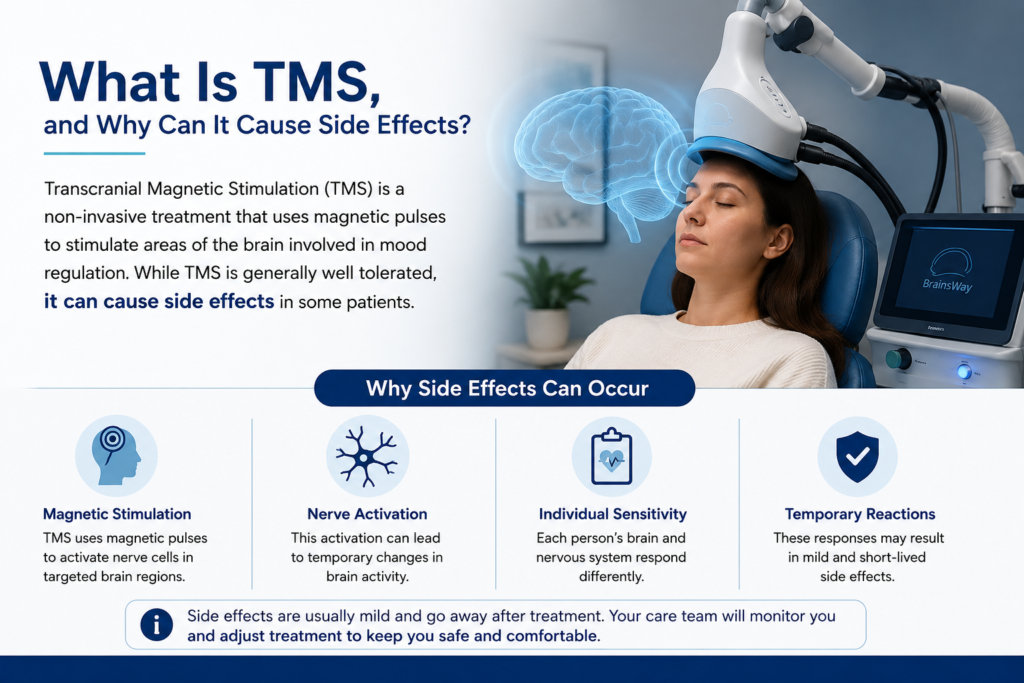
During treatment:
  • The patient remains awake
  • A coil or helmet-like device is positioned on the head
  • Magnetic pulses pass through the scalp
  • The pulses create a tapping sound and sensation
  • Nearby scalp, facial, or jaw muscles may respond
  • No surgical incision is made
  • No electrode is implanted in the brain
  • Anesthesia and sedation are not normally required
What Is TMS, and Why Can It Cause Side Effects

Many common TMS side effects occur because the pulses also stimulate muscles and nerves near the treatment area. This may cause localized discomfort, twitching, tingling, or a tension-type headache.

Different TMS devices, coils, diagnoses, and protocols may produce somewhat different sensations. One patient’s experience should not be treated as a prediction of how every other patient will feel.

Common TMS Side Effects at a Glance

Consideration Psychiatric Medication TMS
How it is delivered Usually taken orally or by another medication route Delivered through an external magnetic coil or helmet
Anesthesia Usually not required Not normally required
Common concerns Depend on the specific medication and patient Often scalp discomfort, headache, twitching, or tingling
Systemic exposure Medication circulates through the body No medication enters the bloodstream
Monitoring Medication response, side effects, interactions, and adherence Treatment comfort, settings, mood response, and safety changes
Serious risks Depend on the medication Rare seizure risk and other uncommon adverse events
Stopping treatment Some medications require gradual tapering Does not create medication withdrawal, although the treatment plan should still be discussed

This table provides general information. Your TMS provider should give you instructions specific to the device and protocol being used.

Headache After TMS

Headache is one of the most commonly discussed TMS side effects.

A TMS-related headache may:

  • Begin during treatment
  • Develop shortly afterward
  • Feel like pressure or muscle tension
  • Occur near the forehead or treatment site
  • Be more noticeable during early sessions
  • Improve as the body becomes accustomed to treatment

Headache can also have causes unrelated to TMS, including dehydration, poor sleep, migraine, caffeine changes, medication effects, stress, or another medical condition.

A sudden severe headache, especially with weakness, numbness, confusion, vision changes, fainting, fever, or difficulty speaking, requires urgent medical evaluation.

Some people can use nonprescription pain medication, but it may not be safe for everyone. Ask the treating clinician what is appropriate given your health history and other medications.

Tell the treatment team if you have:
  • A history of migraine or severe headache
  • A new type of headache
  • Headaches becoming progressively worse
  • Head pain that lasts longer than expected
  • Neurological symptoms with the headache
  • A sudden, severe, or “worst-ever” headache

Scalp Discomfort and Treatment-Site Pain

Patients commonly describe a tapping sensation where the device rests against the head. For some, it feels unusual but manageable. For others, it may be uncomfortable or painful.


Scalp discomfort can be influenced by:

  • Stimulation intensity
  • Device or coil position
  • Individual sensitivity
  • Treatment protocol
  • Muscle tension
  • Headache history
  • Anxiety about the procedure
  • Whether the patient has adjusted to repeated sessions

Do not feel that you must remain silent to prove you can tolerate treatment. The operator needs accurate feedback.

Facial Twitching, Tingling, and Jaw Discomfort

Magnetic stimulation can activate nearby nerves or muscles, resulting in:

Magnetic stimulation can activate nearby nerves or muscles, resulting in:
  • Forehead movement
  • Eyebrow or eyelid twitching
  • Cheek movement
  • Jaw tightening
  • Tooth or facial discomfort
  • Tingling on the scalp or face

These effects usually occur during active stimulation and may stop during pauses between pulse trains.

Report facial or jaw symptoms if they are:
  • Painful
  • Increasing
  • Affecting your ability to remain still
  • Continuing after the session
  • Accompanied by weakness or numbness
  • Different from previous sessions
New facial weakness, one-sided numbness, difficulty speaking, or other possible neurological symptoms should receive urgent medical assessment rather than being assumed to be a normal TMS effect.

Can TMS Make You Dizzy or Lightheaded?

Some patients may experience brief dizziness or lightheadedness. Anxiety, dehydration, missed meals, medications, and changes in blood pressure can also contribute.

If you feel lightheaded:
  • Tell the operator immediately
  • Remain seated
  • Do not stand suddenly
  • Follow the clinic’s instructions
  • Do not drive until you feel fully alert and steady

Fainting is not something to dismiss. The treatment team should assess any loss of consciousness, even if it appears related to anxiety or a vasovagal response.

Call 911 for fainting accompanied by chest pain, severe shortness of breath, injury, prolonged confusion, seizure-like activity, or other concerning symptoms.

Does TMS Cause Fatigue?

Some patients report tiredness after treatment, but fatigue is not specific to TMS. Fatigue may also be related to:
  • Depression
  • Anxiety
  • Poor sleep
  • Medication
  • Travel to repeated appointments
  • Changes in daily routine
  • Medical conditions
  • Alcohol or substance use
  • Emotional strain
Tell the provider if fatigue is severe, worsening, or interfering with daily activities. It may be necessary to review sleep, medication timing, health conditions, or changes in psychiatric symptoms.

New extreme tiredness with weakness, confusion, breathing problems, fever, or another concerning physical symptom requires appropriate medical evaluation.

Is the Clicking Sound Harmful to Hearing?

TMS equipment produces repeated clicking or tapping sounds. Proper hearing protection is an important safety measure.

Patients are commonly instructed to wear earplugs or other approved hearing protection during treatment. The operator should confirm that the protection is positioned correctly and remains in place.

Tell the treatment team immediately if:
  • An earplug becomes loose or falls out
  • The sound becomes painful
  • You notice ringing in the ears
  • Hearing seems muffled
  • You develop ear pain
  • You notice a change in hearing after treatment
Do not remove hearing protection during stimulation unless instructed by the treatment team. Hearing loss is considered an uncommon but potentially serious risk when the ears are not adequately protected. Persistent ringing, pain, or hearing change should be medically evaluated.

Can TMS Cause a Seizure?

A seizure is the most important known serious risk associated with TMS, although it is rare when treatment is appropriately screened and delivered within established safety parameters. A TMS-related seizure, when it occurs, is generally triggered during stimulation. It is not the intended effect of ordinary TMS treatment. Factors that may affect seizure risk include:
  • Personal history of seizures
  • Epilepsy
  • Certain neurological conditions
  • Brain injury
  • Stroke
  • Brain tumor or other structural brain condition
  • Medications that may change the seizure threshold
  • Abrupt medication changes
  • Alcohol withdrawal
  • Withdrawal from sedative medication
  • Heavy alcohol or substance use
  • Severe sleep deprivation
  • Treatment intensity and protocol
  • Incorrect device settings
  • Other individual medical factors
A history of seizures does not mean you should make your own eligibility determination. It means the prescribing clinician needs complete information to evaluate the potential risks and benefits.

Tell the TMS team immediately about:
  • Any past seizure, even if it occurred years ago
  • A family history of epilepsy
  • Fainting or unexplained loss of consciousness
  • Serious head injury
  • Neurological illness
  • Recent medication changes
  • Alcohol or sedative withdrawal
  • Severe sleep loss
  • Use of substances or nonprescribed medication
If a seizure occurs, treatment should stop and the clinical team should follow its emergency protocol. Emergency medical evaluation may be required.

How Do Providers Reduce Seizure Risk?

TMS safety involves more than asking whether someone has epilepsy.

Appropriate precautions may include:
  • Comprehensive medical and psychiatric history
  • Medication and substance-use review
  • Implant and metal screening
  • Review of neurological conditions
  • Review of previous seizures or unexplained loss of consciousness
  • Determination of an individualized motor threshold
  • Use of appropriate stimulation parameters
  • Confirmation of the correct patient, site, and treatment settings
  • Monitoring throughout treatment
  • Staff training in emergency response
  • Reassessment after relevant medical or medication changes
Patients also have an important role. Tell the care team about changes between appointments rather than assuming that previously completed screening is enough.

Medications, Alcohol, Sleep, and Seizure Risk

Your clinical circumstances can change during a multiweek TMS course.

Before each session, report important changes such as:
  • Starting a new prescription
  • Stopping a medication
  • Changing a medication dose
  • Missing several medication doses
  • Starting a new supplement
  • Increased alcohol use
  • Recent substance use
  • Alcohol or sedative withdrawal
  • Severe sleep deprivation
  • Fever or acute illness
  • A recent head injury
  • A seizure or fainting episode
Do not stop medication because you are concerned about TMS safety without speaking to the prescribing clinician. Abruptly stopping certain medications can increase risk.
Be honest about alcohol and substance use. The purpose of screening is to protect your safety, not to punish or shame you.

Can TMS Trigger Mania or Hypomania?

Mood elevation, sometimes described as mania or hypomania, is an uncommon but important potential risk, particularly for people with bipolar disorder or bipolar-spectrum symptoms.

Warning signs may include:
  • Needing much less sleep without feeling tired
  • Unusually elevated or intensely irritable mood
  • Rapid speech
  • Racing thoughts
  • Increased goal-directed activity
  • Inflated confidence
  • Impulsive spending
  • Risky sexual behavior
  • Reckless driving
  • Aggressive or disruptive behavior
  • Making unrealistic plans
  • Feeling unusually powerful or invulnerable

Not every period of improved energy means mania. Depression improvement may naturally involve better motivation and functioning. The provider must consider the degree, pattern, sleep change, behavior, judgment, and personal history.
Report noticeable mood or behavioral changes promptly. Family members may sometimes observe these changes before the patient recognizes them.
Severe agitation, dangerous behavior, psychosis, or an inability to remain safe requires urgent or emergency evaluation.

Does TMS Cause Memory Loss?

TMS is not generally associated with the type of memory loss or post-procedure confusion that can occur with electroconvulsive therapy.

  • Does not usually require anesthesia
  • Does not intentionally trigger a seizure
  • Is not typically associated with significant memory impairment
  • Usually allows patients to remain awake and communicate throughout treatment

This does not mean that every concentration or memory concern during treatment should be dismissed. Depression, anxiety, poor sleep, medication changes, substance use, medical conditions, and other factors can affect cognition.

TMS Side Effects Compared With Antidepressant Side Effects

TMS and medication work differently.

Medication travels through the body and may cause systemic effects. Depending on the medication, these can include gastrointestinal symptoms, sexual side effects, weight changes, sleep changes, sedation, activation, sweating, or other effects.

TMS delivers magnetic stimulation to targeted brain areas and does not circulate through the bloodstream. Its commonly reported side effects are more often localized to the treatment area, such as scalp discomfort or headache.

This does not mean TMS has no side effects or that medication is an inferior treatment. Medication helps many people, and TMS is not appropriate for everyone.

Consideration Psychiatric Medication TMS
How it is delivered Usually taken orally or by another medication route Delivered through an external magnetic coil or helmet
Anesthesia Usually not required Not normally required
Common concerns Depend on the specific medication and patient Often scalp discomfort, headache, twitching, or tingling
Systemic exposure Medication circulates through the body No medication enters the bloodstream
Monitoring Medication response, side effects, interactions, and adherence Treatment comfort, settings, mood response, and safety changes
Serious risks Depend on the medication Rare seizure risk and other uncommon adverse events
Stopping treatment Some medications require gradual tapering Does not create medication withdrawal, although the treatment plan should still be discussed

Never stop psychiatric medication simply because you are beginning TMS. Some patients continue medication during treatment under their prescriber’s direction.

Frequently Asked Questions

What is the most common side effect of TMS?

Scalp discomfort and headache are among the most commonly reported TMS side effects. Patients may also feel tapping, pressure, tingling, or temporary facial-muscle movement during stimulation. Tell the operator about discomfort so it can be assessed.

TMS delivered according to established safety guidelines is not known to cause structural brain damage in routine clinical use. However, inappropriate treatment around certain metal objects or implanted devices could create serious risks. Proper screening, individualized settings, and trained operation are essential.

Yes, but seizure is considered a rare complication. Risk may be affected by seizure history, neurological conditions, medications, withdrawal, substance use, sleep deprivation, and treatment parameters. A detailed safety assessment is required before treatment.

TMS is not typically associated with the memory loss or post-treatment confusion that may occur with ECT. Patients remain awake, and anesthesia is not normally needed. New confusion, significant memory changes, or neurological symptoms should still be reported and evaluated.

Common effects such as headache or scalp discomfort are often temporary and may become less noticeable over repeated sessions. Individual experiences vary. Persistent, severe, worsening, or unusual symptoms should be reported rather than assumed to be normal.

Scroll to Top