Burnout vs Depression: How Can You Tell the Difference?

Burnout vs Depression: How Can You Tell the Difference?

Feeling exhausted, unmotivated, irritable, and disconnected can make it difficult to know what is happening. You may wonder whether you are burned out, depressed, or simply going through an unusually stressful period.

Burnout and depression can look similar, but they are not the same. Burnout is generally associated with chronic workplace stress and often centers on exhaustion, detachment or cynicism toward work, and reduced professional effectiveness. Depression is a mental health condition that can affect mood, interest, sleep, appetite, concentration, self-worth, relationships, and functioning across every part of life.

The distinction is not always clear from symptoms alone. Burnout and depression can occur at the same time, and anxiety, grief, trauma, sleep problems, substance use, medical conditions, and medication effects can create similar experiences.

If the symptoms are persistent, spreading beyond work, or affecting your ability to function, a psychiatric evaluation can help clarify what may be happening.

Quick Answer: What Is the Difference Between Burnout and Depression?

Burnout is most closely connected to chronic workplace stress. It may cause emotional and physical exhaustion, mental distance from the job, cynicism, reduced motivation, and a sense that you are no longer effective at work.

Depression is broader. It may cause a persistent sad, empty, or irritable mood; loss of interest or pleasure; hopelessness; guilt; low energy; sleep or appetite changes; trouble concentrating; withdrawal; and thoughts of death or self-harm. These symptoms can affect work, home, relationships, hobbies, and self-care.

A person with burnout may feel noticeably better when away from the work environment or after meaningful rest and changes to the stressor. A person with depression may continue to feel low, empty, hopeless, or unable to enjoy things even when work pressure is temporarily removed.

This is only a general pattern, not a diagnostic rule.

What Is Burnout?

Burnout is described as an occupational phenomenon rather than a medical condition or formal psychiatric diagnosis. It is associated with chronic workplace stress that has not been successfully managed.

The three commonly recognized dimensions of burnout are:

  1. Energy depletion or exhaustion: Feeling physically, mentally, or emotionally drained by work.
  2. Mental distance, negativity, or cynicism toward the job: Feeling detached from work, coworkers, clients, patients, or the purpose of the role.
  3. Reduced professional effectiveness: Feeling less capable, productive, confident, or successful at work.

People often use the word “burnout” more broadly to describe caregiving strain, parenting exhaustion, academic pressure, or overwhelming life responsibilities. Those experiences are real and may deserve support. However, the formal burnout concept specifically refers to the occupational context.

Burnout should not be treated as a personal weakness or a simple failure to manage time. Workload, staffing, scheduling, control, workplace culture, unclear expectations, conflict, insufficient support, value conflicts, discrimination, and lack of recovery time may all matter.

A solution focused only on individual coping can miss the conditions that are maintaining the stress.

What Is Depression?

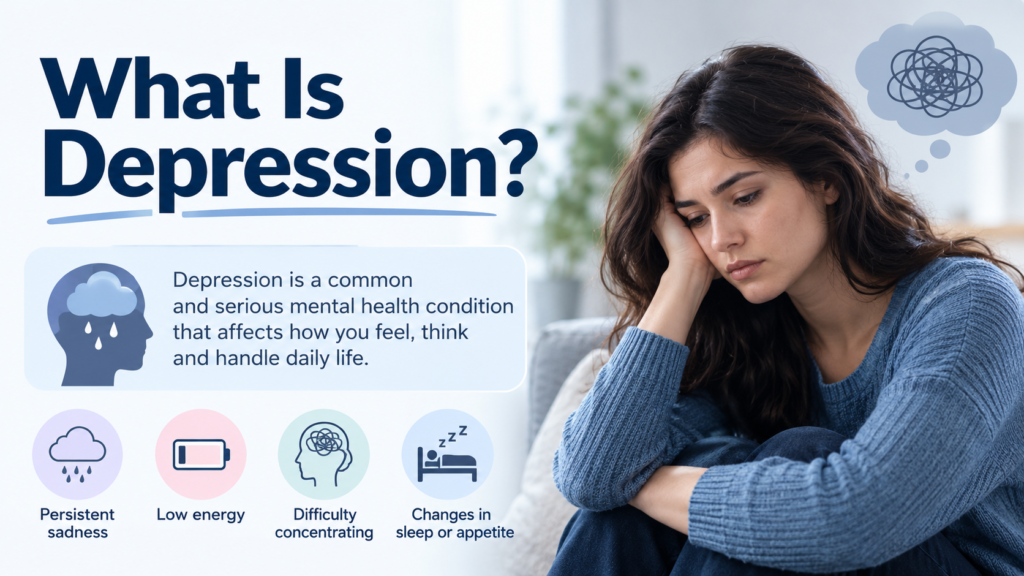
Depression is more than feeling sad after a difficult day. It is a mental health condition that can affect how a person feels, thinks, behaves, and manages ordinary activities.

Major depression commonly involves depressed mood or loss of interest or pleasure for much of the day, on most days, for at least two weeks, along with other symptoms that create distress or interfere with functioning. Only a qualified healthcare professional can diagnose a depressive disorder.

Possible symptoms include:

  • A persistent sad, anxious, empty, or irritable mood.
  • Loss of interest or pleasure in activities.
  • Hopelessness or pessimism.
  • Guilt, worthlessness, or helplessness.
  • Low energy or unusual fatigue.
  • Sleeping too little or too much.
  • Appetite or weight changes.
  • Difficulty concentrating, remembering, or making decisions.
  • Feeling physically slowed down or unusually restless.
  • Social withdrawal and reduced self-care.
  • Thoughts of death, self-harm, or suicide.

Depression may begin during a period of severe work stress, but it is not limited to work. It can affect relationships, leisure, identity, physical well-being, and the ability to experience pleasure or hope.

Burnout vs Depression at a Glance

Question

Burnout may be more likely

Depression may be more likely

Where are symptoms strongest?

Primarily in relation to work or the occupational environment

Across work, home, relationships, interests, and self-care

What emotions stand out?

Exhaustion, frustration, cynicism, resentment, or detachment from work

Sadness, emptiness, hopelessness, guilt, worthlessness, or loss of pleasure

Does time away help?

Symptoms may ease with meaningful rest or distance from the stressor

Symptoms may continue even during weekends, vacation, or reduced workload

Is enjoyment still possible?

Enjoyment may remain available outside work

Interest or pleasure may be reduced across many activities

How is self-worth affected?

Doubt may focus mainly on job performance or professional effectiveness

Negative beliefs may spread to the person’s overall worth, future, or relationships

What about safety?

Burnout alone is not defined by suicidal thinking

Thoughts of death or self-harm can occur and require prompt attention

Is it a diagnosis?

No. Burnout is an occupational phenomenon

Depression is a diagnosable mental health condition

This comparison is not a self-diagnostic tool. People can have mixed patterns, and burnout can coexist with depression, anxiety, trauma, substance use, or a medical condition.

Symptoms Burnout and Depression Can Share

Burnout and depression overlap enough that guessing from one symptom can be misleading. Both may involve:

  • Fatigue or feeling emotionally drained.
  • Sleep disruption.
  • Irritability or frustration.
  • Difficulty concentrating.
  • Reduced motivation.
  • Procrastination or declining productivity.
  • Withdrawal from coworkers, friends, or family.
  • Feeling ineffective or overwhelmed.
  • Physical tension, headaches, or digestive discomfort.
  • Increased alcohol or substance use as a way to cope.

The surrounding pattern provides more information than any single symptom. A clinician will want to know when the symptoms began, where they occur, whether they improve away from work, how they affect other areas of life, and whether low mood or loss of pleasure is present.

Signs That May Point More Toward Burnout

Burnout may be more likely when symptoms are closely tied to work and become noticeably stronger during the workday, before a shift, on Sunday evening, or when thinking about job responsibilities.

You may notice:

  • Feeling emotionally depleted before the workday begins.
  • Becoming cynical, impatient, or detached toward work.
  • Dreading messages, meetings, deadlines, clients, patients, or coworkers.
  • Feeling that your work no longer has meaning.
  • Reduced confidence in your professional ability.
  • Making more mistakes or struggling to complete tasks.
  • Feeling trapped by workload or workplace expectations.
  • Using all your energy to get through work and having little left afterward.
  • Feeling temporary relief during a genuine break from work.

Burnout can still affect life outside the workplace. A person may be too exhausted to socialize, exercise, prepare meals, or participate in family life.

That spillover does not automatically make it depression, but it is a sign that the stress is affecting overall functioning and deserves attention.

Signs That May Point More Toward Depression

Depression may be more likely when the symptoms extend across most settings and continue even when the work stressor is absent.

Signs that deserve a closer evaluation include:

  • Feeling low, empty, hopeless, or emotionally numb most days.
  • Losing interest or pleasure in hobbies, relationships, food, intimacy, or activities that usually matter.
  • Feeling worthless, excessively guilty, or like a burden.
  • Believing that nothing will improve, even if the work situation changes.
  • Experiencing significant sleep or appetite changes.
  • Having difficulty with basic self-care or household tasks.
  • Withdrawing from nearly everyone, not only coworkers.
  • Feeling unable to enjoy weekends, vacations, or time away.
  • Experiencing thoughts of death, self-harm, or suicide.

Depression does not always involve visible sadness. Some people primarily notice irritability, exhaustion, emotional flatness, physical discomfort, or a loss of motivation.

Others continue performing at work while privately struggling in every other part of life.

Can You Have Burnout and Depression at the Same Time?

Can You Have Burnout and Depression at the Same Time

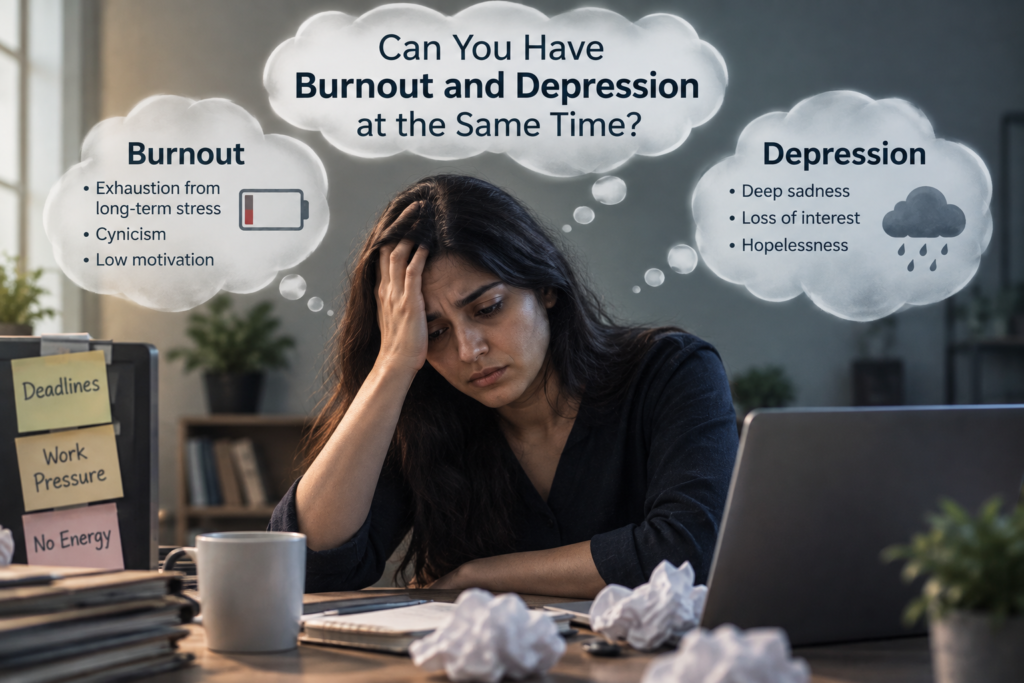
Yes. Burnout and depression are not mutually exclusive. A person can experience chronic workplace stress and also meet criteria for a depressive disorder. Burnout symptoms may also make it harder to notice when a broader mental health problem is developing.

For example, someone may initially feel cynical and exhausted only at work. Over time, they may stop enjoying friends, hobbies, food, exercise, or family activities. Sleep may become disrupted, hopelessness may increase, and the sense of failure may spread beyond professional performance.

That broader pattern deserves a mental health evaluation.

The reverse can also happen. A person with depression may experience poor concentration, low energy, and reduced motivation at work and assume that the job is the only problem. Changing roles may help with a harmful work environment, but it may not fully address an underlying depressive disorder.

The purpose of an evaluation is not to force the experience into one category. It is to identify all the factors that may be contributing and create a plan that addresses them.

Am I Burned Out or Depressed? Questions to Consider

The following questions may help you organize what you are experiencing. They are not a scored test and cannot diagnose burnout or depression.

1. Where do the symptoms show up?

Do exhaustion, dread, irritability, and detachment appear mainly around work? Or do they also affect weekends, relationships, hobbies, meals, exercise, and self-care?

2. Can you still experience enjoyment?

When you are away from work, can you become interested in people or activities? A broad loss of interest or pleasure may point toward depression and should be discussed with a professional.

3. Does meaningful rest change how you feel?

Do symptoms improve after sleep, time off, support, or distance from the workplace? Burnout may ease when recovery is possible and work conditions change. Depression may remain present despite rest.

Many people experience a mixture, so this question is informative rather than decisive.

4. What are you telling yourself?

Burnout-related thoughts may focus on professional effectiveness: “I cannot keep up,” “This job is draining me,” or “My work no longer matters.”

Depression may produce broader thoughts such as “I am worthless,” “Nothing will improve,” or “Everyone would be better without me.”

5. How long has this been happening?

Has the pattern continued for weeks or months? Is it becoming more intense? Persistent symptoms, declining functioning, or an inability to recover are reasons to seek help regardless of the label.

6. Has your sleep, appetite, or self-care changed?

Burnout and depression can both affect these areas. Significant or continuing changes may also have medical causes and deserve evaluation.

7. Are you using alcohol or other substances to cope?

Increasing substance use can worsen mood, sleep, anxiety, health, and safety. It is important to share this information honestly with a clinician.

8. Do you feel safe?

Any thoughts of death, self-harm, suicide, or being unable to remain safe require prompt support. Do not dismiss these thoughts as “just burnout.”

Call or text 988 in the United States. Call 911 or go to the nearest emergency room for immediate danger.

Why It Can Be Hard to Tell the Difference

Exhaustion changes how people think, feel, and behave. When someone has been under pressure for a long time, it may be difficult to remember what their normal energy or motivation felt like. They may also minimize symptoms because the workplace culture treats chronic exhaustion as expected.

Burnout and depression can both interfere with sleep, concentration, motivation, relationships, and physical comfort. A short vacation may not resolve burnout if the person returns to the same unmanageable conditions.

Likewise, a person with depression may experience brief moments of relief without the underlying condition being resolved.

Other issues can complicate the picture. Anxiety may cause racing thoughts, tension, and poor sleep. Trauma can produce withdrawal, irritability, numbness, or hypervigilance. Grief can affect energy, concentration, and interest.

Sleep disorders, chronic pain, thyroid problems, anemia, hormonal changes, medication effects, and substance use can resemble or intensify emotional symptoms.

An evaluation considers these possibilities instead of relying on a single online comparison.

When Should You Seek Professional Help?

You do not need to know whether the correct word is burnout, depression, stress, or anxiety before asking for help.

Consider a psychiatric or mental health evaluation when:

  • Symptoms have lasted two weeks or longer.
  • Rest, weekends, or time away are no longer helping.
  • Exhaustion is affecting work, relationships, or self-care.
  • You have lost interest in activities outside work.
  • Sleep, appetite, concentration, or motivation has changed significantly.
  • You feel hopeless, worthless, trapped, or unable to recover.
  • You are using alcohol or other substances more often to cope.
  • Work stress is triggering panic, trauma symptoms, or severe anxiety.
  • You are making errors or having difficulty performing safely at work.
  • You are considering quitting impulsively because you feel unable to continue.
  • Symptoms keep returning after temporary improvement.
  • You are already receiving treatment but are not improving enough.
  • You have thoughts of death, self-harm, suicide, or harming someone else.

Seeking an evaluation does not automatically mean you will receive a diagnosis or medication. It creates space to understand the symptoms, identify risks, and discuss appropriate options.

What Happens During a Psychiatric Evaluation?

A psychiatric evaluation looks at more than your workload. The clinician may ask about mood, interest, energy, sleep, appetite, concentration, anxiety, irritability, physical symptoms, substance use, medical history, medications, and safety.

The clinician may recommend coordination with a primary care clinician, therapist, or another professional if physical health, sleep, substance use, or workplace issues require additional attention.

The goal is not to blame the person for failing to cope. It is to understand whether the symptoms reflect occupational burnout, depression, anxiety, another condition, or several problems occurring together.

They may also explore:

  • When the symptoms began and what was happening at the time.
  • Whether symptoms occur mainly at work or across different settings.
  • How you feel during weekends, vacations, or periods of reduced workload.
  • Your responsibilities, schedule, level of control, workplace relationships, and support.
  • Whether the job conflicts with your values or creates moral distress.
  • Previous episodes of depression, anxiety, trauma, or burnout.
  • Family mental health history.
  • Current medical conditions, medications, and supplements.
  • Previous periods of unusually elevated mood, reduced need for sleep, racing thoughts, or impulsive behavior.
  • The effect on work performance, relationships, and daily functioning.

How Treatment May Differ for Burnout and Depression

Burnout and depression may share symptoms, but the care plan should address the underlying pattern.

Support for occupational burnout

Burnout support may involve identifying the work conditions that are driving chronic stress. Depending on the situation, helpful changes could include a manageable workload, clearer priorities, improved staffing, greater control, realistic schedules, protected recovery time, stronger boundaries, supervisory support, or a change in role.

Individual strategies such as sleep, movement, nutrition, relaxation, time away, social support, and therapy may support recovery. They should not be used to suggest that a person can simply breathe or exercise their way through an unsafe or unsustainable workplace.

A therapist or psychiatrist may help with anxiety, perfectionism, guilt, conflict, trauma reactions, emotional regulation, or decisions about work.

Medication is not a direct treatment for burnout itself, but it may be considered when a diagnosable condition such as depression or an anxiety disorder is also present.

Treatment for depression

Depression treatment may include psychotherapy, medication management, lifestyle and sleep support, coordination with other healthcare professionals, or a combination of approaches.

The plan depends on the diagnosis, symptom severity, safety, previous treatment, medical history, and patient preferences.

For eligible patients whose depression has not improved enough with previous treatment, a psychiatrist may review advanced options such as BrainsWay Deep TMS®.

Deep TMS® is not a treatment for occupational burnout by itself. Eligibility depends on a qualifying diagnosis, treatment history, medical and safety factors, and provider evaluation.

When both are present

If burnout and depression occur together, treating only one side may leave important problems unresolved.

Reducing depression symptoms may help energy and functioning, but returning to an unchanged harmful environment may continue the strain. Changing the work situation may reduce stress, but depression may still require clinical treatment.

A combined plan can address symptoms, workplace realities, physical health, recovery, and longer-term mental wellness.

Burnout and Depression Care at Sunny Skies Healthcare in Chicago

Sunny Skies Healthcare provides compassionate psychiatric support for stress, burnout symptoms, depression, anxiety, sleep disruption, emotional exhaustion, and related concerns in Chicago’s West Loop.

Care begins with understanding the full picture. A psychiatric evaluation can review where the symptoms occur, how long they have lasted, how they affect daily life, and whether depression, anxiety, trauma, grief, medical factors, medication effects, or substance use may be contributing.

Depending on the evaluation, care may include medication management when appropriate, therapy coordination, lifestyle-focused guidance, holistic mental wellness support, or evaluation of advanced treatment options for an eligible diagnosed condition.

Sunny Skies Healthcare does not treat burnout as an automatic indication for Deep TMS®. If a person experiencing burnout symptoms also has depression or another potentially qualifying condition, eligibility can be reviewed based on diagnosis, treatment history, medications, medical history, implants, seizure risk, and overall clinical safety.

Frequently Asked Questions

Is burnout a mental health diagnosis?

No. Burnout is generally classified as an occupational phenomenon associated with chronic workplace stress, not as a formal mental health diagnosis.Its commonly recognized features are exhaustion, increased mental distance or cynicism toward work, and reduced professional effectiveness. A person with burnout may also have depression, anxiety, or another diagnosable condition.

Burnout and depression have a complex relationship and can occur together. A person experiencing chronic workplace stress may develop symptoms that spread beyond work, including loss of interest, hopelessness, guilt, sleep or appetite changes, and impaired self-care.These broader symptoms should be evaluated rather than assumed to be burnout alone.

Meaningful time away and changes to workplace stress may help burnout. A short break may provide limited relief if the same conditions return immediately.Depression can continue during weekends or vacations and may require clinical treatment. Improvement with time off can provide useful information, but it does not confirm or rule out either condition.

Exhaustion can be related to burnout, depression, anxiety, poor sleep, medication effects, substance use, chronic pain, thyroid problems, anemia, sleep apnea, or other medical conditions.Seek an evaluation when fatigue persists, becomes severe, or is accompanied by mood changes, physical symptoms, or reduced functioning.

Consider seeing a psychiatrist when symptoms last two weeks or longer, spread beyond work, interfere with sleep or daily functioning, do not improve with rest, or include persistent low mood, loss of interest, hopelessness, or substance use.Seek immediate crisis or emergency help for thoughts of self-harm, suicide, or danger to yourself or someone else.

Take the Next Step

You do not need to diagnose yourself before requesting support. If exhaustion, detachment, low mood, or loss of motivation is affecting your work and the rest of your life, Sunny Skies Healthcare can help you review the full pattern and discuss appropriate next steps.

Scroll to Top