High-Functioning Depression: Signs People Often Miss

Someone can arrive at work on time, meet deadlines, care for a family, maintain friendships, and appear successful while privately struggling with depression symptoms. From the outside, life may look organized. Internally, every responsibility may require enormous effort.

“High-functioning depression” is a commonly used phrase, not a formal psychiatric diagnosis. It is often used to describe people who experience persistent low mood, loss of pleasure, exhaustion, self-criticism, or emotional numbness while continuing to meet many outward responsibilities.

The phrase does not tell a clinician which depressive disorder, if any, is present. A person may have major depressive disorder, persistent depressive disorder, another mental health condition, a medical issue, or symptoms that do not meet criteria for a specific diagnosis. A psychiatric evaluation is needed to understand the full pattern.

If you look capable on the outside but feel empty, hopeless, disconnected, or exhausted inside, you do not need to wait until you can no longer function before asking for help.

Quick Answer: What Is High-Functioning Depression?

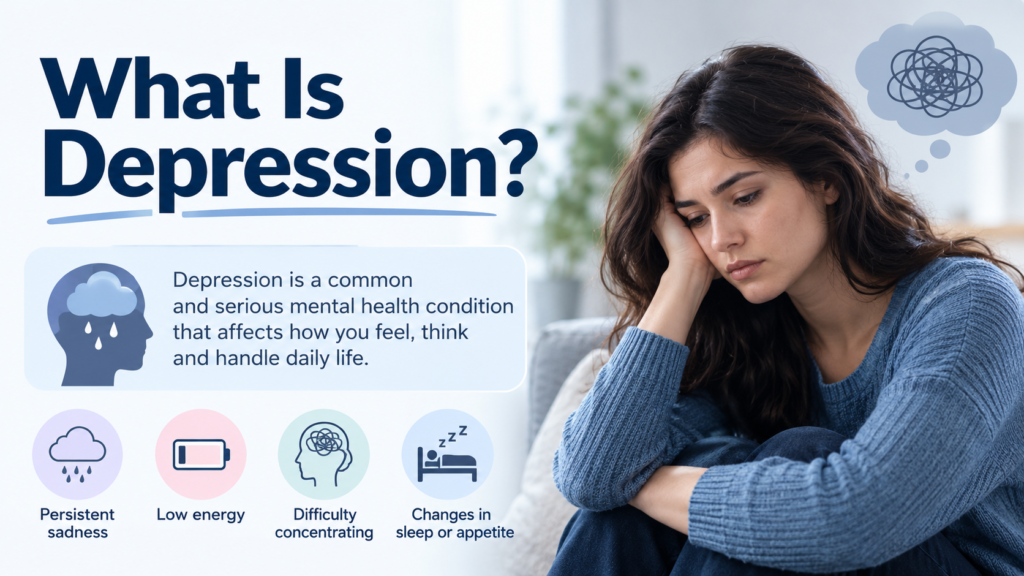
High-functioning depression is an informal phrase used for depression symptoms that may be hidden behind work, school, caregiving, social activity, or other responsibilities. The person may appear dependable and productive while experiencing low mood, reduced enjoyment, fatigue, guilt, hopelessness, difficulty concentrating, sleep changes, or emotional disconnection.

It is not a separate medical diagnosis and should not be used to diagnose yourself or someone else. It also does not mean the depression is mild. A person’s ability to complete tasks does not reveal the amount of distress, effort, or suffering involved.

Professional help may be appropriate when symptoms last two weeks or longer, keep returning, affect quality of life, or require so much effort that there is little energy left for relationships, self-care, or enjoyment.
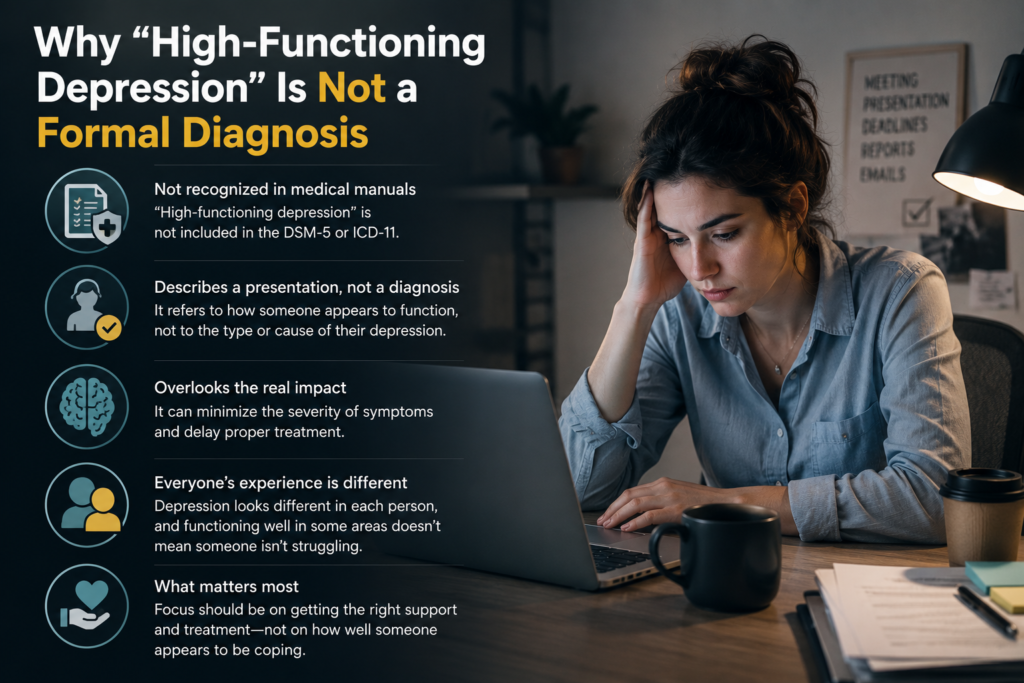
Why “High-Functioning Depression” Is Not a Formal Diagnosis

Mental health diagnoses are based on defined patterns of symptoms, duration, severity, medical history, and impairment. “High-functioning depression” is not one of those defined diagnostic categories.

The phrase can still be useful in ordinary conversation because it describes an experience many people recognize: “I am still doing what I have to do, but I do not feel like myself.”

The problem occurs when the phrase is treated as a confirmed diagnosis or as another name for one particular depressive disorder.

Why “High-Functioning Depression” Is Not a Formal Diagnosis

Persistent depressive disorder is a recognized diagnosis involving a long-lasting pattern of depressive symptoms. In adults, the pattern generally continues for at least two years. It was previously called dysthymia.

Some people with persistent depressive disorder may continue working or caring for others, but “high-functioning depression” and persistent depressive disorder are not interchangeable terms.

Major depressive disorder may also occur in a person who remains outwardly productive. Although depression can impair functioning, impairment does not always mean a complete inability to work, parent, socialize, or manage daily tasks.

A person may compensate, hide symptoms, reduce activity in other areas, or use nearly all available energy to maintain essential responsibilities.

A clinician may also discover that symptoms are better explained by anxiety, burnout, grief, trauma, bipolar disorder, substance use, a sleep disorder, medication effects, chronic pain, or another medical condition.

Why Hidden Depression Is Easy to Miss

People often expect depression to look like crying, staying in bed, missing work, or being unable to complete basic tasks. Those experiences can occur, but they are not the only way depression appears.

Friends, relatives, and coworkers may genuinely believe the person is doing well. Compliments such as “You always have everything together” can make disclosure feel even harder.

Hidden symptoms may be missed because the person:

  • Continues to meet deadlines and responsibilities.
  • Appears calm, cheerful, social, or highly organized.
  • Is known as dependable and does not want to disappoint others.
  • Uses routines, perfectionism, or overwork to maintain control.
  • Minimizes symptoms because other people “have it worse.”
  • Feels ashamed about struggling despite an outwardly successful life.
  • Has lived with low mood for so long that it feels like part of their personality.
  • Avoids asking for help because they fear being viewed differently.
  • Uses humor, busyness, exercise, alcohol, or other behaviors to distract from emotional pain.
  • Recovers privately after performing well in public.

Signs of High-Functioning Depression People May Overlook

No single sign confirms depression. The pattern, duration, distress, and effect on life matter more than any one behavior.

1. Everything takes more effort than it appears

You may complete your responsibilities but need intense effort, rigid routines, or constant self-pressure to do so. A normal workday may leave you unable to prepare food, answer messages, exercise, or interact with family afterward.

Other people see the completed task. They may not see the exhaustion, procrastination, panic, negative self-talk, or recovery time behind it.

2. You rarely feel pleasure or anticipation

You may continue participating in hobbies, celebrations, travel, meals, or social events without feeling genuinely interested or rewarded. You attend because it is expected, not because you want to be there.

Loss of interest or pleasure is an important depression symptom. It may feel like emotional flatness rather than obvious sadness.

3. Productivity becomes a way to avoid how you feel

Staying busy can provide structure and temporary distraction. You may take on more projects, work longer hours, or focus intensely on other people’s needs because slowing down allows difficult thoughts or emotions to surface.

Productivity itself is not a sign of depression. The concern is a pattern in which achievement becomes the main way you manage emotional pain, while rest creates guilt, emptiness, or anxiety.

4. Your inner voice is consistently harsh

You may appear confident while privately believing that you are failing, disappointing people, or never doing enough. Accomplishments provide only brief relief before the standard rises again.

Persistent guilt, worthlessness, hopelessness, and excessive self-criticism deserve attention, especially when they are present even when there is evidence that you are capable and valued.

5. You feel emotionally numb or disconnected

Depression does not always feel like intense sadness. It can feel like moving through the day on autopilot, watching yourself from a distance, or being unable to connect emotionally with people you care about.

You may say the right things, smile, and participate while feeling absent inside. Emotional numbness can also occur with trauma and other conditions, so an evaluation is important.

6. Rest does not feel restorative

You may sleep for a normal amount of time and still wake exhausted. A weekend, day off, or vacation may reduce work pressure without restoring motivation or enjoyment.

Fatigue can also have medical causes, including sleep disorders, anemia, thyroid problems, chronic pain, medication effects, and other conditions. Persistent fatigue should not automatically be assumed to be depression.

7. Sleep or appetite has changed

You may struggle to fall asleep, wake repeatedly, wake very early, or sleep much longer than usual. Appetite may increase or decrease.

Some people use food for comfort, forget to eat, or follow strict routines that hide a change from others.

Sleep and appetite changes can affect concentration, mood, energy, and physical health. They are worth discussing with a healthcare professional when they persist.

8. Irritability is more noticeable than sadness

You may become impatient, easily overwhelmed, sensitive to noise, or frustrated by small problems. Loved ones may notice that you seem distant or short-tempered even though you deny feeling sad.

Irritability can occur with depression, anxiety, burnout, sleep deprivation, trauma, substance use, and medical conditions. The wider symptom pattern helps clarify its meaning.

9. You withdraw in ways that are easy to explain

You may cancel plans because you are “busy,” stop replying because you are “tired,” or avoid intimacy because work has been “a lot.”

Each explanation may sound reasonable, but the overall pattern can gradually reduce connection and support.

Some people remain socially active in structured settings while avoiding deeper conversations about how they feel.

10. You rely on alcohol or other substances to switch off

Alcohol, cannabis, sedatives, stimulants, or other substances may become a way to sleep, relax, perform, or feel something. Use may appear controlled while gradually becoming more frequent or necessary.

Substances can worsen mood, anxiety, sleep, concentration, health, and safety. Honest disclosure helps the clinician understand the full picture without judgment.

11. Physical discomfort becomes part of daily life

Depression may occur with headaches, body aches, digestive discomfort, tension, heaviness, or other physical complaints.

Physical symptoms should be evaluated rather than dismissed as psychological because medical conditions and depression can coexist.

12. You think about disappearing, not waking up, or being a burden

Some people who appear highly functional experience thoughts of death or self-harm. They may hide the thoughts because they believe others would not understand or because their responsibilities appear intact.

Any thought that you would be better off dead, that others would be better without you, or that you might hurt yourself requires prompt attention.

Call or text 988 in the United States. Call 911 or go to the nearest emergency room if you may act, have a plan, cannot remain safe, or are in immediate danger.

How Can Someone Be Depressed and Still Function?

People adapt to distress in different ways. Some withdraw visibly, while others become more controlled, productive, or focused on responsibility.

Several factors may help someone maintain outward functioning temporarily:

  • Strong routines and external structure.
  • Fear of failure, consequences, or disappointing others.
  • Perfectionism or a strong identity built around achievement.
  • Financial, caregiving, or professional responsibilities that feel impossible to pause.
  • Privacy, shame, or concern about stigma.
  • Support from family, coworkers, or practical resources.
  • Symptoms that affect internal quality of life more than visible task completion.
  • Reducing hobbies, rest, relationships, or self-care to preserve energy for essential duties.

High-Functioning Depression vs Persistent Depressive Disorder

These terms are often confused online, but they are not equivalent.

High-functioning depression

Persistent depressive disorder

Informal, commonly used phrase

Formal mental health diagnosis

Describes outward functioning despite depressive symptoms

Defined by a long-lasting depressive symptom pattern

Does not specify symptom duration

In adults, symptoms generally persist for at least two years

May refer to several possible diagnoses or concerns

Requires a clinical assessment and diagnostic criteria

Cannot determine treatment by itself

Treatment is based on an individualized clinical evaluation

A person described as “high functioning” may or may not have persistent depressive disorder.

They could instead have major depression, an anxiety disorder, burnout, trauma-related symptoms, bipolar depression, grief, a medical condition, or another concern.

Questions to Ask Yourself

These questions can help you organize your experience, but they are not a diagnostic test.

  1. Have I felt low, empty, irritable, or emotionally numb most days?
  2. Do I still enjoy activities, relationships, or accomplishments?
  3. How much effort does it take to maintain my responsibilities?
  4. What happens when I am no longer performing for other people?
  5. Have I withdrawn from hobbies, intimacy, friends, or family?
  6. Has my sleep, appetite, concentration, or energy changed?
  7. Do I feel guilty when resting or believe I am never doing enough?
  8. Am I relying on work, alcohol, food, exercise, or other behaviors to avoid difficult feelings?
  9. Have the symptoms lasted at least two weeks, continued for months, or kept returning?
  10. Do I feel hopeless, worthless, trapped, or like a burden?
  11. Have I had periods of unusually high energy, reduced need for sleep, racing thoughts, or impulsive behavior?
  12. Have I thought about death, disappearing, self-harm, or suicide?

If you answered yes to several questions, consider discussing the pattern with a qualified mental health professional.

A checklist cannot determine the diagnosis, but your concerns are valid even if you are still meeting responsibilities.

What Else Can Look Like High-Functioning Depression?

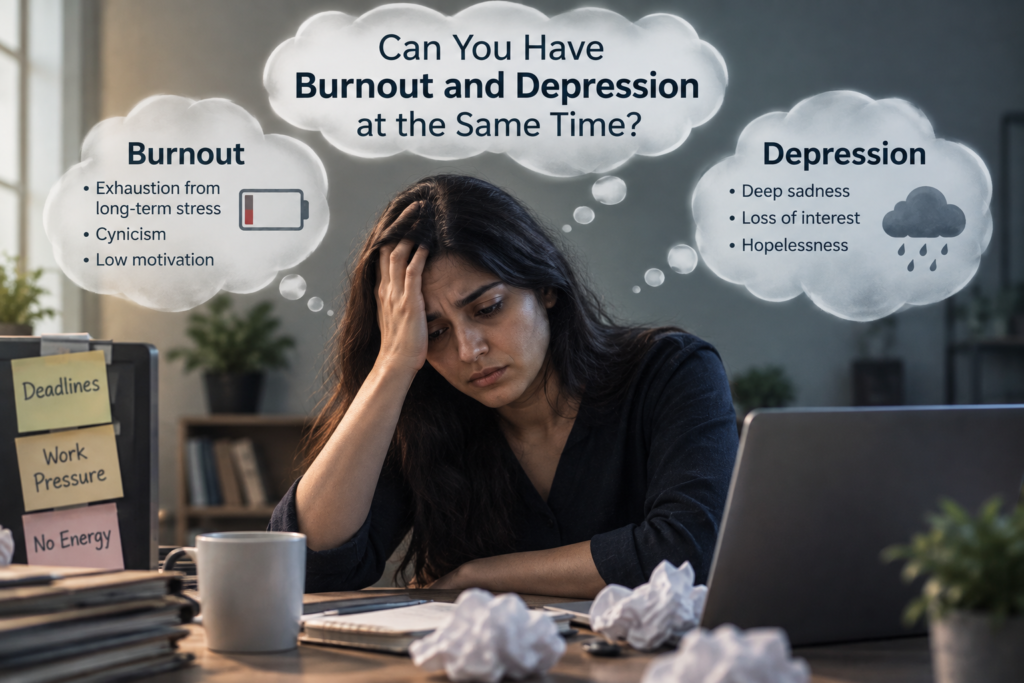
Can You Have Burnout and Depression at the Same Time

Several mental and physical health concerns can resemble hidden depression or occur alongside it.

Burnout

Burnout is connected primarily to chronic workplace stress and may involve exhaustion, cynicism, detachment from work, and reduced professional effectiveness.

Depression is broader and may affect pleasure, hope, self-worth, and functioning across settings.

Anxiety

Anxiety can create constant tension, overthinking, perfectionism, sleep problems, irritability, and exhaustion.

Some people remain highly productive because anxiety drives them to overprepare or avoid mistakes. Anxiety and depression can occur together.

Trauma-related symptoms

Trauma may cause emotional numbness, avoidance, hypervigilance, detachment, shame, sleep disturbance, or difficulty trusting other people.

A trauma-informed evaluation can help differentiate overlapping patterns.

Bipolar disorder

Bipolar disorder can include depressive episodes as well as periods of unusually elevated or irritable mood, increased energy or activity, reduced need for sleep, racing thoughts, or impulsive behavior.

A complete mood history is important before choosing treatment.

Grief

Grief can affect sleep, concentration, energy, appetite, and interest. Grief and depression can also coexist.

The clinician considers timing, emotional patterns, self-worth, functioning, and safety rather than assuming one explanation.

Medical conditions and medication effects

Sleep apnea, thyroid problems, anemia, chronic pain, hormonal changes, neurological conditions, nutritional concerns, medications, and substance use may contribute to fatigue, low mood, cognitive difficulty, or sleep changes.

Evaluation may include coordination with a primary care clinician when appropriate.

When Should You Seek Professional Help?

You do not need to wait until you miss work, stop caring for yourself, or experience a crisis.

Consider a psychiatric or mental health evaluation when:

  • Low mood, numbness, irritability, or loss of interest lasts two weeks or longer.
  • Symptoms keep returning or have become part of daily life.
  • Maintaining responsibilities requires unsustainable effort.
  • You have little energy left for relationships, rest, or self-care.
  • Sleep, appetite, concentration, or physical health has changed.
  • You feel guilty, worthless, hopeless, trapped, or like a burden.
  • Work or achievement is the main way you avoid difficult emotions.
  • Alcohol or other substance use is increasing.
  • Therapy or medication is not helping enough.
  • People close to you have noticed a meaningful change.
  • You are unsure whether the symptoms reflect depression, anxiety, burnout, trauma, bipolar disorder, grief, or a medical condition.
  • You have thoughts of death, self-harm, suicide, or being unable to remain safe.

Any safety-related thought deserves prompt attention regardless of how well you appear to be functioning.

What Happens During a Psychiatric Evaluation?

A psychiatric evaluation looks beyond outward performance. The clinician may ask about mood, interest, energy, sleep, appetite, concentration, physical symptoms, self-worth, substance use, relationships, work, medical history, medications, and safety.

They may also review:

  • When symptoms began and how long they last.
  • Whether symptoms are constant, episodic, seasonal, or linked to stressors.
  • How much effort is required to maintain daily responsibilities.
  • Which parts of life have been reduced or neglected.
  • Previous depression, anxiety, trauma, grief, or burnout.
  • Family mental health history.
  • Therapy and medication already tried.
  • Current medical conditions, supplements, and substance use.
  • Previous periods of elevated mood, less need for sleep, racing thoughts, or impulsive behavior.
  • Immediate and long-term safety.

The evaluation may lead to a depressive disorder diagnosis, another diagnosis, or a conclusion that more information is needed.

The purpose is not to apply the “high-functioning” label. It is to understand the complete pattern and identify appropriate next steps.

Treatment Options for Hidden Depression Symptoms

Treatment depends on the diagnosis, symptom severity, duration, safety, medical history, previous treatment, and patient preferences.

Psychotherapy

Therapy may help identify patterns of self-criticism, perfectionism, avoidance, overwork, guilt, emotional disconnection, trauma, or relationship stress.

It can also help build coping skills and create changes that support more than outward performance.

Medication management

Medication may be appropriate for some diagnosed conditions. A psychiatric provider can review potential benefits, risks, side effects, interactions, previous treatment, and monitoring.

Medication should not be started, stopped, or changed without a qualified prescriber.

Sleep, medical, and lifestyle support

Sleep, nutrition, movement, routine, social connection, stress, pain, and physical health may affect mental well-being.

These areas can support a broader care plan, but they should not be presented as a cure or a substitute for appropriate clinical care.

Advanced treatment options

For eligible patients with depression who have not improved enough with previous treatment, a psychiatrist may discuss options such as BrainsWay Deep TMS®.

Deep TMS® is not used because someone identifies with the phrase “high-functioning depression.” Eligibility depends on a formal diagnosis, treatment history, medications, medical and safety factors, implants, seizure risk, and provider evaluation.

Depression Evaluation at Sunny Skies Healthcare in Chicago

Sunny Skies Healthcare provides compassionate, patient-centered psychiatric care in Chicago’s West Loop for people experiencing depression, treatment-resistant depression, anxious depression, emotional numbness, low motivation, and related concerns.

Care begins with the full picture rather than whether a person appears functional. A psychiatric evaluation can review symptoms, duration, daily effort, relationships, sleep, medical history, medication history, previous treatment, stress, substance use, and goals.

Depending on the evaluation, care may include medication management when appropriate, therapy coordination, lifestyle-focused guidance, holistic mental wellness support, or review of advanced treatment options such as BrainsWay Deep TMS® for eligible patients.

You do not have to wait until responsibilities begin to collapse. If you are still functioning but no longer feel like yourself, a private conversation can be a reasonable first step.

Frequently Asked Questions

Is high-functioning depression a real diagnosis?

No. “High-functioning depression” is a commonly used phrase, not a formal psychiatric diagnosis.It describes the experience of having depression symptoms while maintaining outward responsibilities. A clinician may diagnose major depressive disorder, persistent depressive disorder, another condition, or no specific disorder after a complete evaluation.

No. Persistent depressive disorder is a formal diagnosis involving a long-lasting pattern of depressive symptoms, generally for at least two years in adults.High-functioning depression is an informal phrase that does not specify symptom duration or diagnosis. Some people may identify with both descriptions, but they are not interchangeable.

Yes. Some people continue performing well while depression affects their internal well-being, relationships, sleep, energy, or ability to experience pleasure.They may use routines, perfectionism, fear of failure, or most of their available energy to maintain work performance. Success does not rule out depression.

Consider an evaluation when symptoms last two weeks or longer, keep returning, reduce enjoyment, affect sleep or relationships, require unsustainable effort, or cause hopelessness or substance use.Seek immediate help for thoughts of self-harm, suicide, or being unable to remain safe.

Depression symptoms can become more severe or disruptive over time, although every person’s course is different.Outward functioning may become harder to maintain, and untreated symptoms may affect health, relationships, work, or safety. Seeking help before a crisis can clarify the cause and identify appropriate support.

Take the Next Step

Looking capable does not mean you must manage depression symptoms alone.

If daily life feels heavy, joyless, disconnected, or sustained mainly through pressure and performance, Sunny Skies Healthcare can help you discuss what you are experiencing and review appropriate next steps.

Scroll to Top